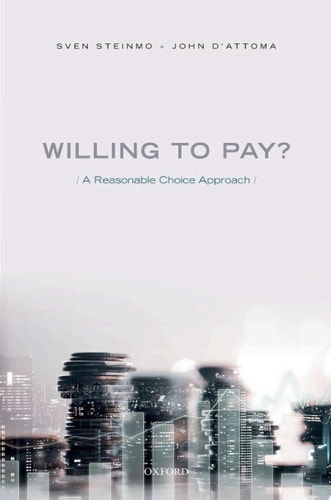
Willing to Pay?: A Reasonable Choice Approach
0
0
As an Amazon Associate and affiliate partner, Menrva Books earns from qualifying purchases. Learn more
Author Description
Why do people in some societies tend to follow rules and obey the laws more than those in other societies? Is the difference institutional, or is 'culture' a better explanation? These are the central questions confronted in this book. This study explores these questions through a large laboratory experimental study which examined tax compliance behaviour in four countries: Sweden, Italy, Britain and the United States. We present what we call a 'Reasonable Choice Approach' demonstrating that most people are motivated to comply with social rules when the rules are clear, coherent, and consistent. This theory argues that most people are both rationally self-interested and social animals who have strong desires to behave according to the norms of their societies. Willing to Pay? demonstrates how institutions can shape individual behaviours and thereby help explain why social behaviours are so different across societies.
Menrva's Summary
THE THESIS
This book investigates why tax compliance behavior varies significantly across different societies by examining the tension between institutional structures and cultural norms. Authors John D'Attoma and Sven Steinmo utilize a 'Reasonable Choice Approach' to argue that individuals are both rationally self-interested and socially motivated. By analyzing experimental data, they demonstrate that compliance increases when social rules are perceived as clear, coherent, and consistent, suggesting that institutions play a primary role in shaping individual behavior.
THE SCOPE MAP
What You Will Find
- A comparative analysis of tax compliance behavior across Sweden, Italy, Britain, and the United States.
- The 'Reasonable Choice Approach' framework for understanding social rule adherence.
- Data derived from large-scale laboratory experiments.
Scope Limits
- The study does not cover tax systems in developing nations or non-Western institutional frameworks.
- The analysis focuses primarily on laboratory-based behavioral experiments rather than longitudinal real-world tax audit data.
THE AUTHORITY PERSPECTIVE
Experts recognize this work as a significant contribution to the intersection of behavioral economics and political science. Readers frequently note the clarity of the authors' theoretical framework when applied to cross-national institutional comparisons.
Page Count:
157
Publication Date:
2021-01-01
Publisher:
OUP Oxford
ISBN-10:
0192516949
ISBN-13:
9780192516947
Economics
Behavioral Science
Sociology
Comparative Politics
Taxation
Community Tags
Similar Books