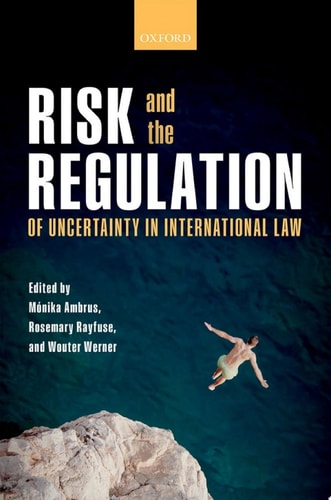
Risk and the Regulation of Uncertainty in International Law
0
0
As an Amazon Associate and affiliate partner, Menrva Books earns from qualifying purchases. Learn more
Author Description
Increasingly, international legal arrangements imagine future worlds or create space for experts to articulate how the future can be conceptualized and managed. With the increased specialization of international law, a series of functional regimes and sub-regimes has emerged, each with their own imageries, vocabularies, expert-knowledge, and rules to translate our hopes and fears for the future into action in the present. At issue in the development of these regimes are not just competing predictions of the future based on what we know about what has happened in the past and what we know is happening in the present. Rather, these regimes seek to deal with futures about which we know very little or nothing at all; futures that are inherently uncertain and even potentially catastrophic; futures for which we need to find ways to identify, conceptualise, manage, and regulate risks the existence of which we can possibly only speculate about. This book explores how the future is imagined, articulated, and managed across the various fields of international law, including the use of force, maritime security, international economic and environmental law, and human rights. It investigates how the future is construed in these various areas; how the costs of risk, risk regulation, risk assessment, and risk management are distributed in international law; the effect of uncertain futures on the subjects of international law; and the way in which international law operates when faced with catastrophic or existential risk.
Menrva's Summary
THE THESIS
This book investigates how international legal regimes conceptualize, manage, and regulate risks associated with inherently uncertain and potentially catastrophic future events. The authors, Monika Ambrus, Rosemary Rayfuse, and Wouter Werner, examine the intersection of expert knowledge and legal frameworks to understand how international law translates speculative future scenarios into present-day regulatory action. By analyzing various functional regimes, the text argues that these systems are not merely predictive but are active constructions of future realities that distribute the costs and responsibilities of risk management across global subjects.
THE SCOPE MAP
What You Will Find
- Analysis of risk regulation in maritime security, international economic law, and environmental law.
- Examination of how international law addresses existential and catastrophic threats.
- Theoretical frameworks regarding the distribution of risk-related costs.
- Investigations into the role of expert knowledge in legal decision-making.
Scope Limits
- The text does not provide a comprehensive manual for specific risk-mitigation techniques.
- It does not cover domestic or municipal legal applications of risk theory.
THE AUTHORITY PERSPECTIVE
Experts identify this work as a significant contribution to the study of international legal theory and the sociology of law. Readers frequently note the academic density of the prose, which is intended for scholars and practitioners engaged in international governance and policy analysis.
Page Count:
304
Publication Date:
2017-01-01
Publisher:
OUP Oxford
ISBN-10:
0192515438
ISBN-13:
9780192515438
Legal Theory
International Law
Professional Career & Trade
Human rights
Community Tags
Similar Books