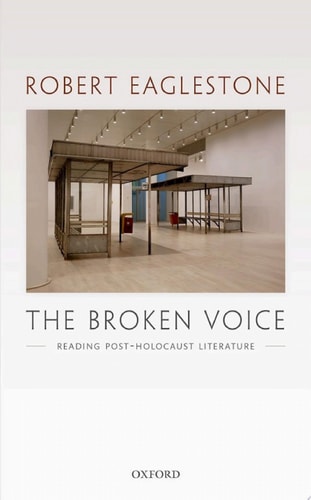
The Broken Voice: Reading Post-Holocaust Literature
0
0
As an Amazon Associate and affiliate partner, Menrva Books earns from qualifying purchases. Learn more
Author Description
'Which writer today is not a writer of the Holocaust?' asked the late Imre Kertész, Hungarian survivor and novelist, in his Nobel acceptance speech: 'one does not have to choose the Holocaust as one's subject to detect the broken voice that has dominated modern European art for decades'. Robert Eaglestone attends to this broken voice in literature in order to explore the meaning of the Holocaust in the contemporary world, arguing, again following Kertész, that the Holocaust will 'remain through culture, which is really the vessel of memory'. Drawing on the thought of Hannah Arendt, Eaglestone identifies and develops five concepts--the public secret, evil, stasis, disorientalism, and kitsch--in a range of texts by significant writers (including Kazuo Ishiguro, Jonathan Littell, Imre Kertész, W. G. Sebald, and Joseph Conrad) as well as in work by victims and perpetrators of the Holocaust and of atrocities in Africa. He explores the interweaving of complicity, responsibility, temporality, and the often problematic powers of narrative which make up some part of the legacy of the Holocaust.
Menrva's Summary
THE THESIS
This book investigates how the Holocaust functions as a foundational, albeit often implicit, influence on the structure and voice of contemporary European literature. Robert Eaglestone, a scholar of contemporary literature and thought, utilizes the framework of Imre Kertész’s 'broken voice' to examine how the trauma of the Holocaust persists within cultural memory. By integrating the political and philosophical insights of Hannah Arendt, the author argues that modern art remains inextricably linked to the legacy of these atrocities, regardless of whether the Holocaust is the explicit subject of the work.
THE SCOPE MAP
What You Will Find
- Analysis of five core conceptual frameworks: the public secret, evil, stasis, disorientalism, and kitsch.
- Comparative study of literary works by authors including Kazuo Ishiguro, Jonathan Littell, Imre Kertész, W. G. Sebald, and Joseph Conrad.
- Examination of texts produced by both victims and perpetrators of the Holocaust and African atrocities.
Scope Limits
- The analysis does not provide a comprehensive historical account of the Holocaust itself.
- The text focuses primarily on the literary and cultural legacy rather than providing a sociological study of survivor communities.
THE AUTHORITY PERSPECTIVE
Scholars and critics recognize this work as a significant contribution to the intersection of trauma studies and literary theory. Readers frequently note the academic density of the prose, which requires a foundational understanding of contemporary critical theory to fully engage with the author's arguments.
Page Count:
208
Publication Date:
2017-01-01
Publisher:
OUP Oxford
ISBN-10:
0192525689
ISBN-13:
9780192525680
Philosophy
Literary Criticism
English
Criticism history
European
English & College Success
Community Tags
Similar Books