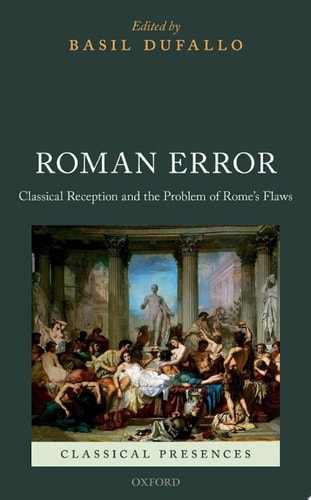
Roman Error: Classical Reception and the Problem of Rome's Flaws
0
0
As an Amazon Associate and affiliate partner, Menrva Books earns from qualifying purchases. Learn more
Author Description
In the eyes of posterity, ancient Rome is deeply flawed. The list of censures is long and varied, from political corruption and the practice of slavery, to religious intolerance and sexual immorality, yet for centuries the Romans' "errors" have not only provoked opprobrium, but also inspired wayward and novel forms of thought and representation, themselves errant in the broad sense of the Latin verb. This volume is the first to examine this phenomenon in depth, treating examples from history, philosophy, literature, psychoanalysis, and art history, from antiquity to the present, to examine how the Romans' faults have become the basis for creative experimentation, for rejections of prevailing ideology, even for comedy and delight. In demonstrating that the reception of Rome's missteps and mistakes has been far more complex than simply denouncing them as an exemplum malum to be shunned and avoided, it argues compellingly that these "alternative" receptions are historically important and enduringly relevant in their own right. "Roman error" comes to signify both ancient misstep and something that we may commit when engaging with Roman antiquity, whereby reception may even be conceived as "error" of a kind: while the volume ably addresses popular fascination with a wide range of Roman vices, including violence, imperial domination, and decadence, it also asks us to consider what makes certain receptions matter, how they matter, and why.
Menrva's Summary
THE THESIS
This volume investigates how the perceived moral and political flaws of ancient Rome have functioned as productive catalysts for creative and intellectual experimentation across history. Basil Dufallo, a scholar of classical reception, synthesizes perspectives from philosophy, psychoanalysis, and art history to argue that Roman 'errors'—ranging from imperial violence to decadence—are not merely subjects for condemnation. Instead, he posits that these missteps have historically enabled thinkers and artists to challenge prevailing ideologies and develop novel modes of representation.
THE SCOPE MAP
What You Will Find
- Analysis of Roman vices including slavery, corruption, and sexual immorality
- Examination of the reception of Roman history in literature and psychoanalysis
- Theoretical framework for understanding 'error' as a creative act in classical reception
Scope Limits
- Does not provide a comprehensive history of Roman political or social institutions
- Does not focus on archaeological evidence or material culture outside of its reception context
THE AUTHORITY PERSPECTIVE
Scholars in the field of classical reception view this work as a significant contribution to the study of how antiquity is mediated through modern lenses. Readers frequently note the academic density of the prose and the interdisciplinary breadth of the author's argument.
Page Count:
336
Publication Date:
2017-01-01
Publisher:
OUP Oxford
ISBN-10:
0192524194
ISBN-13:
9780192524195
History
Philosophy
English
Rome
Literary Criticism
Ancient History
Art History
English & College Success
Community Tags
Similar Books