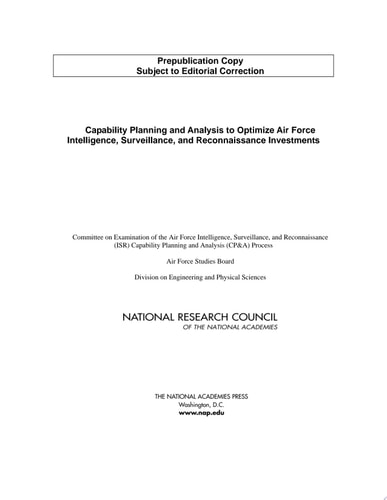
Capability Planning and Analysis to Optimize Air Force Intelligence, Surveillance, and Reconnaissance Investments
0
0
As an Amazon Associate and affiliate partner, Menrva Books earns from qualifying purchases. Learn more
Author Description
Intelligence, surveillance, and reconnaissance (ISR) capabilities have expanded situation awareness for U.S. forces, provided for more precise combat effects, and enabled better decision making both during conflicts and in peacetime, and reliance on ISR capabilities is expected to increase in the future. ISR capabilities are critical to 3 of the 12 Service Core Functions of the U.S. Air Force: namely, Global Integrated ISR (GIISR) and the ISR components of Cyberspace Superiority and Space Superiority, and contribute to all others. In response to a request from the Air Force for ISR and the Deputy Assistant Secretary of the Air Force for Science, Technology, and Engineering, the National Research Council formed the Committee on Examination of the Air Force Intelligence, Surveillance, and Reconnaissance (ISR) Capability Planning and Analysis (CP&A) Process. In this report, the committee reviews the current approach to the Air Force corporate planning and programming process for ISR capability generation; examines carious analytical methods, processes, and models for large-scale, complex domains like ISR; and identifies the best practices for the Air Force. In Capability Planning and Analysis to Optimize Air Force Intelligence, Surveillance, and Reconnaissance Investments, the current approach is analyzed and the best practices for the Air Force corporate planning and programming processed for ISR are recommended. This report also recommends improvements and changes to existing analytical tools, methods, roles and responsibilities, and organization and management that would be required to ensure the Air Force corporate planning and programming process for ISR is successful in addressing all Joint, National, and Coalition partner's needs.
Menrva's Summary
THE THESIS
This report critically examines the U.S. Air Force's processes for planning and analyzing intelligence, surveillance, and reconnaissance (ISR) capabilities to optimize investment decisions. The National Research Council, at the request of the Air Force, formed a committee to review the current approach to ISR capability generation within the Air Force's corporate planning and programming framework. The committee analyzed various analytical methods, processes, and models applicable to complex domains like ISR, identifying best practices. The report offers recommendations for improvements to analytical tools, methods, roles, responsibilities, and organizational structures to ensure the Air Force can effectively meet the needs of joint, national, and coalition partners through its ISR capabilities.
THE SCOPE MAP
- Review of the current Air Force corporate planning and programming process for ISR capability generation.
- Examination of analytical methods, processes, and models for large-scale, complex domains like ISR.
- Identification of best practices for the Air Force in ISR capability planning and analysis.
- Analysis of the current approach to ISR investment.
- Recommendations for improvements to analytical tools and methods.
- Recommendations for changes to roles, responsibilities, organization, and management within the ISR planning process.
- Focus on ensuring the Air Force corporate planning and programming process for ISR addresses Joint, National, and Coalition partner needs.
THE AUTHORITY PERSPECTIVE
This report is a formal assessment by the National Research Council, commissioned by the U.S. Air Force, to evaluate its ISR capability planning and analysis processes. The work focuses on identifying best practices and recommending improvements to optimize investments in critical intelligence, surveillance, and reconnaissance capabilities. The committee's findings and recommendations are intended to enhance the Air Force's ability to meet the complex needs of various partners through its ISR programs. The report serves as a technical guide for strategic planning and resource allocation within the Air Force's ISR domain.
Page Count:
148
Publication Date:
2012-12-07
Publisher:
National Academies Press
ISBN-10:
0309258146
ISBN-13:
9780309258142
Non-Fiction
Science & Technology
Community Tags
Similar Books














Reader Comments
Share Your Thoughts
No comments yet. Be the first to share your thoughts!