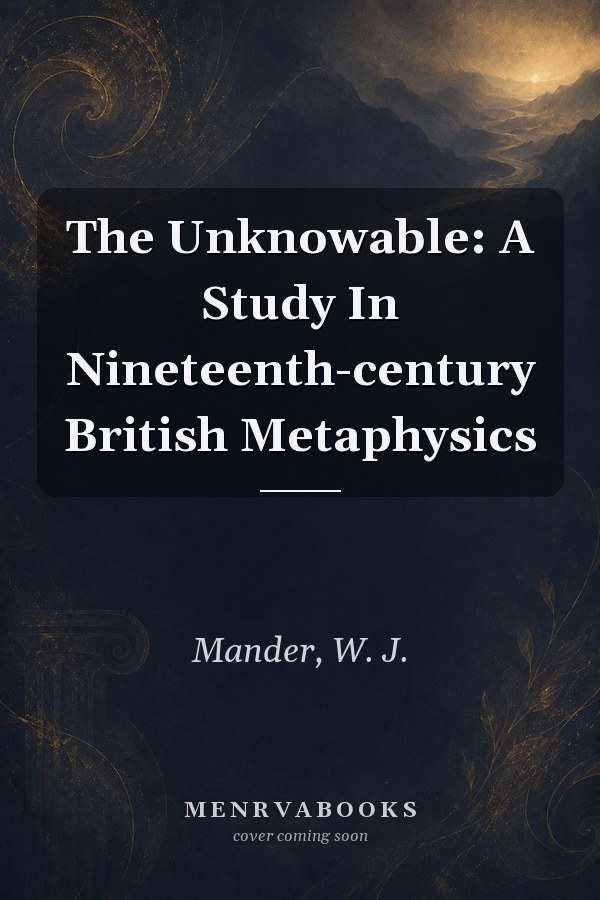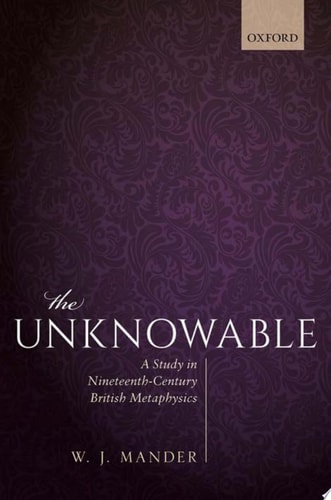
The Unknowable: A Study in Nineteenth-Century British Metaphysics
0
0
As an Amazon Associate and affiliate partner, Menrva Books earns from qualifying purchases. Learn more
Author Description
Cover -- The Unknowable: A Study In Nineteenth-century British Metaphysics -- Copyright -- Contents -- List Of Illustrations -- Introduction -- Part I: The Unconditioned -- 1: Sir William Hamilton -- 1.1 The Way Of 'learned Ignorance' -- 1.2 The Relativity Of Knowledge -- 1.3 The Law Of The Conditioned -- 1.4 Common Sense And The Existence Of The Unconditioned -- 1.5 Hamilton And Kant -- 1.6 Substance And Adjective -- 1.7 Space And Time -- 1.8 Causality -- 1.9 The Question Of Free Will -- 1.10 God -- 1.11 Concluding Remarks -- 2: Henry Longueville Mansel -- 2.1 The Philosophy Of Kant 2.2 Negative Reason: The Impossibility Of Thinking Of God -- 2.3 Positive Reason: Belief In The Existence Of God -- 2.4 Theology, Revelation, And Faith -- 2.5 Mill's Objections To Mansel -- 2.6 Space And Time -- 2.7 Substance, Mind, And Matter -- 2.8 Causality And Freedom -- 2.9 Concluding Remarks -- 3: Herbert Spencer -- 3.1 Spencer's Epistemology -- 3.2 The Religion Of The Unknowable -- 3.3 Science And The Unknowable -- 3.4 Space, Time, And Matter -- 3.5 Force And Causation -- 3.6 Spencer's Psychology -- 3.7 Concluding Remarks -- 4: Thomas Henry Huxley -- 4.1 Agnosticism And Metaphysics 4.2 Agnosticism And Epistemology -- 4.3 Huxley On God -- 4.4 Huxley On Causation -- 4.5 Huxley On The External World -- 4.6 Huxley On The Self -- 4.7 Evolution And Ethics -- Part Ii: Empiricist Objections -- 5: John Stuart Mill -- 5.1 Mill's Empiricism And His Attitude Towards The Unknowable -- 5.2 Mill On Time And Space -- 5.3 Mill On Matter (phenomenalism) -- 5.4 Mill On The Self -- 5.5 Mill On Causation -- 5.6 Mill On Free Will -- 5.7 Mill On Laws -- 5.8 Mill On God And Religion -- 6: Alexander Bain And George Croom Robertson -- 6.1 Alexander Bain -- 6.2 Bain's Empiricism -- 6.3 Time And Space 6.4 Phenomenalism And The External World -- 6.5 Causation, Uniformity, And Force -- 6.6 The Self, The Mind-body Relation, And Human Freedom -- 6.7 Things-in-themselves -- 6.8 George Croom Robertson -- 6.9 Meth
Menrva's Summary
THE THESIS
This book investigates the philosophical problem of the 'Unknowable' as it was debated by nineteenth-century British thinkers. W. J. Mander, a scholar of British idealism, examines how various philosophers navigated the limits of human cognition and the nature of reality. By analyzing the works of figures like Hamilton, Mansel, Spencer, and Mill, the author constructs a framework for understanding how these thinkers reconciled empirical observation with metaphysical claims about the absolute or the divine.
THE SCOPE MAP
What You Will Find
- Detailed analysis of the 'Law of the Conditioned' and its influence on Victorian thought.
- Comparative studies of empiricist versus idealist approaches to space, time, and causality.
- Examination of the theological implications of agnosticism in the nineteenth century.
Scope Limits
- The text focuses primarily on British thinkers and does not provide an exhaustive survey of Continental European metaphysical developments.
- The analysis concludes with the late nineteenth-century empiricist tradition and does not extend into twentieth-century analytic philosophy.
THE AUTHORITY PERSPECTIVE
Scholars recognize this work as a rigorous and specialized examination of a pivotal era in British philosophical history. Readers frequently note the academic density of the prose, which is intended for students and researchers familiar with the technical terminology of the period.
Page Count:
320
Publication Date:
2020-01-01
Publisher:
Oxford University Press,
ISBN-10:
0192537369
ISBN-13:
9780192537362
Philosophy
Epistemology
Metaphysics
19th Century
Philosophers
British Philosophy
Philosophy history
History of Ideas
Knowledge Theory
Great Britain
Community Tags
Similar Books