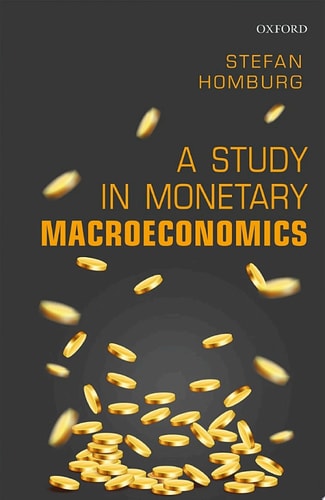
A Study in Monetary Macroeconomics
0
0
As an Amazon Associate and affiliate partner, Menrva Books earns from qualifying purchases. Learn more
Author Description
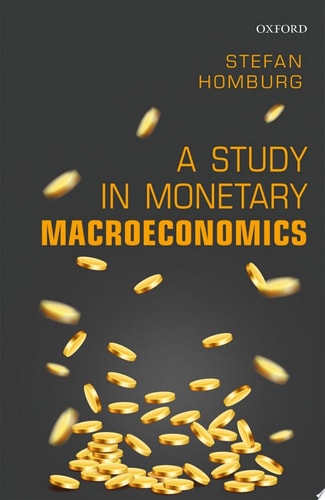
The financial crisis of 2007 and the following recession present a major challenge to macroeconomic theory. The same holds true for exceptionally low interest rates during the recent years and for the puzzle that super-expansive monetary policies failed to produce high inflation. Approaches that focus on steady states, rational expectations, and individuals planning over infinite horizons, are not suitable for analysing such abnormal situations. A Study in Monetary Macroeconomics refines and improves mainstream approaches to resolve these puzzles and to contribute to a better understanding of monetary and fiscal policies. Using a rich institutional structure that includes features such as credit money, external finance, borrowing constraints, net worth, real estate and commercial banks, this timely study reduces rationality requirements to cope with its complex setting. It starts with a simple baseline model, deriving results from mathematical reasoning and simulations whilst adhering to the method of dynamic general equilibrium (DGE) with optimizing agents and fully specified models. Highly topical, A Study in Monetary Macroeconomics uses a unified theoretical framework to demonstrate that a DGE approach makes it possible to develop clean models that work outside steady states and are appropriate for answering macroeconomic questions of actual interest.
Menrva's Summary
THE THESIS
This book investigates how to reconcile mainstream macroeconomic theory with the anomalies of the post-2007 financial crisis, including low interest rates and the absence of expected inflation. Stefan Homburg, a professor of public finance, utilizes his expertise in dynamic general equilibrium (DGE) modeling to challenge the limitations of traditional steady-state analysis. By relaxing strict rationality requirements and incorporating complex institutional variables, the author constructs a framework capable of analyzing abnormal economic conditions and the efficacy of monetary and fiscal interventions.
THE SCOPE MAP
What You Will Find
- A unified theoretical framework for dynamic general equilibrium modeling.
- Integration of institutional factors such as credit money, external finance, and borrowing constraints.
- Mathematical simulations demonstrating model behavior outside of steady states.
Scope Limits
- The text does not provide a comprehensive history of the 2007 financial crisis itself.
- It does not offer policy prescriptions for non-market economies or developing nations lacking commercial banking structures.
THE AUTHORITY PERSPECTIVE
Experts recognize this work as a rigorous attempt to modernize DGE models for contemporary economic challenges. Readers frequently note the high level of mathematical density, making it most suitable for advanced students and professional economists.
Page Count:
217
Publication Date:
2017-01-01
Publisher:
OUP Oxford
ISBN-10:
0192534556
ISBN-13:
9780192534552
Economics
Academic
Money Supply
Finance
Principles of Macroeconomics
Macroeconomics
Community Tags
Other Editions(3)

Similar Books