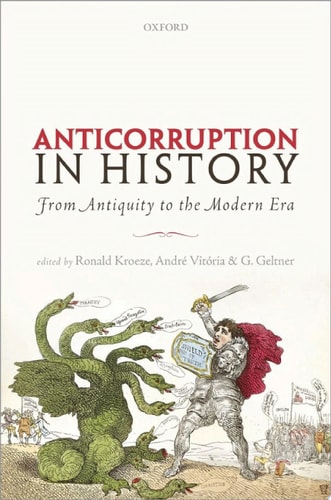
Anticorruption in History: From Antiquity to the Modern Era
0
0
As an Amazon Associate and affiliate partner, Menrva Books earns from qualifying purchases. Learn more
Author Description
Anticorruption in History is a timely and urgent book: corruption is widely seen today as a major problem we face as a global society, undermining trust in government and financial institutions, economic efficiency, the principle of equality before the law and human wellbeing in general. Corruption, in short, is a major hurdle on the "path to Denmark" a feted blueprint for stable and successful statebuilding. The resonance of this view explains why efforts to promote anticorruption policies have proliferated in recent years. But while the subject of corruption and anticorruption has captured the attention of politicians, scholars, NGOs and the global media, scant attention has been paid to the link between corruption and the change of anticorruption policies over time and place, with the attendant diversity in how to define, identify and address corruption. Economists, political scientists and policy-makers in particular have been generally content with tracing the differences between low-corruption and high-corruption countries in the present and enshrining them in all manner of rankings and indices. The long-term trends—social, political, economic, cultural—potentially undergirding the position of various countries plays a very small role. Such a historical approach could help explain major moments of change in the past as well as reasons for the success and failure of specific anticorruption policies and their relation to a country's image (of itself or as construed from outside) as being more or less corrupt. It is precisely this scholarly lacuna that the present volume intends to begin to fill. The book addresses a wide range of historical contexts: Ancient Greece and Rome, Medieval Eurasia, Italy, France, Great Britain and Portugal as well as studies on anticorruption in the Early Modern and Modern era in Romania, the Ottoman Empire, the Netherlands, Germany, Denmark, Sweden and the former German Democratic Republic.
Menrva's Summary
THE THESIS
This volume investigates the historical evolution of corruption and the corresponding development of anticorruption policies across diverse global contexts from antiquity to the modern era. The authors, a team of expert historians, argue that contemporary discourse on corruption often lacks historical depth, relying too heavily on static indices rather than examining the long-term social, political, and cultural trends that shape institutional integrity. By analyzing how different societies have defined, identified, and addressed corruption over centuries, the book provides a framework for understanding why specific anticorruption measures succeed or fail in varying historical environments.
THE SCOPE MAP
What You Will Find
- Comparative historical analysis of corruption across Ancient Greece, Rome, and Medieval Eurasia.
- Case studies focusing on Italy, France, Great Britain, Portugal, the Ottoman Empire, and the Netherlands.
- Examination of modern anticorruption efforts in Germany, Denmark, Sweden, and the former German Democratic Republic.
- A critical assessment of how state-building and national identity influence perceptions of corruption.
Scope Limits
- The text does not provide a contemporary manual for modern policy implementation or current global corruption rankings.
- It does not offer a singular, universal definition of corruption, focusing instead on the diversity of historical interpretations.
THE AUTHORITY PERSPECTIVE
Experts identify this work as a significant scholarly intervention that bridges the gap between historical research and contemporary political science. Readers frequently note the academic density of the prose, which serves as a foundational resource for those seeking to understand the long-term trajectories of institutional governance.
Page Count:
457
Publication Date:
2017-01-01
Publisher:
OUP Oxford
ISBN-10:
0192538047
ISBN-13:
9780192538048
True Crime
History
Governance
Global Studies
Corruption Studies
Sociology
European History
Community Tags
Similar Books


Reader Comments
Share Your Thoughts
No comments yet. Be the first to share your thoughts!