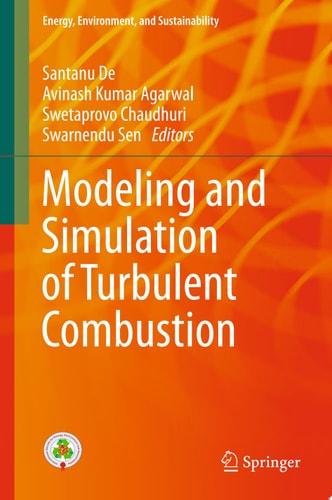
Modeling and Simulation of Turbulent Combustion
0
0
As an Amazon Associate and affiliate partner, Menrva Books earns from qualifying purchases. Learn more
Author Description
This book presents a comprehensive review of state-of-the-art models for turbulent combustion, with special emphasis on the theory, development and applications of combustion models in practical combustion systems. It simplifies the complex multi-scale and nonlinear interaction between chemistry and turbulence to allow a broader audience to understand the modeling and numerical simulations of turbulent combustion, which remains at the forefront of research due to its industrial relevance. Further, the book provides a holistic view by covering a diverse range of basic and advanced topics—from the fundamentals of turbulence–chemistry interactions, role of high-performance computing in combustion simulations, and optimization and reduction techniques for chemical kinetics, to state-of-the-art modeling strategies for turbulent premixed and nonpremixed combustion and their applications in engineering contexts.
Menrva's Summary
THE THESIS
This book investigates the complex interplay between turbulence and chemistry in combustion processes. Santanu De, an expert in the field, provides a comprehensive review of current models for turbulent combustion, focusing on their theoretical underpinnings, development, and practical applications. The work aims to simplify the intricate multi-scale and nonlinear interactions, making advanced modeling and numerical simulations accessible to a wider audience. It covers fundamental concepts, the role of high-performance computing, chemical kinetics optimization, and advanced modeling strategies for various combustion types.
THE SCOPE MAP
- State-of-the-art models for turbulent combustion.
- Theory, development, and applications of combustion models.
- Simplification of multi-scale and nonlinear turbulence-chemistry interactions.
- Fundamentals of turbulence-chemistry interactions.
- Role of high-performance computing in combustion simulations.
- Optimization and reduction techniques for chemical kinetics.
- Modeling strategies for turbulent premixed and nonpremixed combustion and their engineering applications.
THE AUTHORITY PERSPECTIVE
The book is presented as a comprehensive review of current models in turbulent combustion, aiming to bridge the gap between complex theory and practical application for a broader audience. Its focus on simplifying intricate interactions and covering diverse topics suggests it is intended for researchers and engineers seeking to understand and apply advanced simulation techniques. The inclusion of fundamentals, computational aspects, and specific modeling strategies indicates a thorough approach to the subject matter.
Page Count:
661
Publication Date:
2017-12-12
Publisher:
Springer Nature
ISBN-10:
9811074100
ISBN-13:
9789811074103
Science & Technology
Science
Non-Fiction
Combustion
Engineering
Community Tags
Similar Books