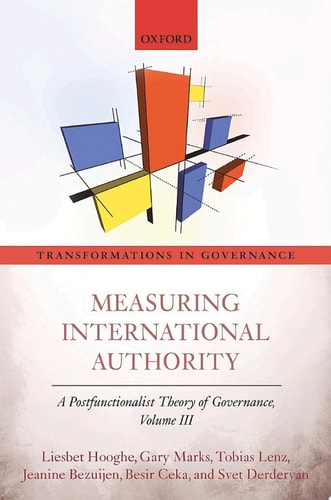
Measuring International Authority: A Postfunctionalist Theory of Governance, Volume III
0
0
As an Amazon Associate and affiliate partner, Menrva Books earns from qualifying purchases. Learn more
Author Description
This is the third of five ambitious volumes theorizing the structure of governance above and below the central state. This book is written for those interested in the character, causes, and consequences of governance within the state. This book sets out a measure of authority for seventy-six international organizations (IOs) from 1950, or the time of their establishment, to 2010 which can allow researchers to test expectations about the character, sources, and consequences of international governance. The international organizations considered are regional (e.g. the EU, Andean Community, NAFTA), cross-regional (e.g. the Commonwealth of Nations, the Organization of Islamic Cooperation), and global (e.g. the UN, World Bank, WTO). Firstly, the book introduces carefully constructed estimates for the scope and depth of authority exercised by international governments. The estimates are unique in their comparative scope, their specificity, and time span. Secondly, it describes describe broad trends in IO authority by comparing delegation and pooling, over time, across IOs, and across decision areas. Thirdly, it presents the evidence gathered by the authors to estimate international authority by carefully discussing forty-seven international organizations, and showing how their bodies are composed, what decisions each body makes, and how they make decisions. Transformations in Governance is a major new academic book series from Oxford University Press. It is designed to accommodate the impressive growth of research in comparative politics, international relations, public policy, federalism, environmental and urban studies concerned with the dispersion of authority from central states up to supranational institutions, down to subnational governments, and side-ways to public-private networks. It brings together work that significantly advances our understanding of the organization, causes, and consequences of multilevel and complex governance. The series is selective, containing
Menrva's Summary
THE THESIS
This volume investigates the evolution of international authority by establishing a quantitative framework to measure the scope and depth of governance exercised by international organizations. The authors, a team of established scholars in political science and international relations, utilize a longitudinal dataset covering seventy-six international organizations from 1950 to 2010. By analyzing the mechanisms of delegation and pooling, the text provides a systematic method for researchers to evaluate the shifting power dynamics between central states and supranational institutions.
THE SCOPE MAP
What You Will Find
- A comprehensive dataset measuring authority across seventy-six international organizations.
- Comparative analysis of regional, cross-regional, and global governance structures.
- Detailed case studies of forty-seven specific international organizations.
- Methodological tools for assessing decision-making processes and organizational composition.
Scope Limits
- The analysis is restricted to the period between 1950 and 2010.
- The text focuses primarily on formal international organizations rather than informal diplomatic networks.
THE AUTHORITY PERSPECTIVE
Scholars in the field of international relations recognize this work as a foundational resource for quantitative research on multilevel governance. Readers frequently note the academic density of the prose and the rigorous nature of the data collection, making it a standard reference for those studying the structural evolution of international institutions.
Page Count:
907
Publication Date:
2017-01-01
Publisher:
OUP Oxford
ISBN-10:
0192536028
ISBN-13:
9780192536020
International relations
Public Policy
Comparative Politics
Governance
Academic
Community Tags
Similar Books








Reader Comments
Share Your Thoughts
No comments yet. Be the first to share your thoughts!