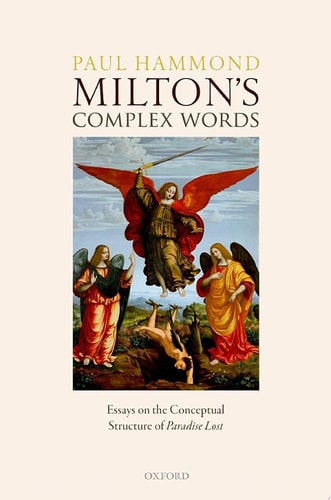
Milton's Complex Words: Essays on the Conceptual Structure of Paradise Lost
0
0
As an Amazon Associate and affiliate partner, Menrva Books earns from qualifying purchases. Learn more
Author Description
Every major poet or philosopher develops their own distinctive semantic field around those terms which matter most to them, or which contribute most profoundly to the imagined world of a particular work. This book explores the specific meanings which Milton develops around key words in Paradise Lost. Some of these are theological or philosophical terms (e.g. 'evil', 'grace', 'reason'); others are words which shape the imagined world of the poem (e.g. 'dark', 'fall', 'within'); yet others are small words or even prefixes which subtly move the argument in new directions (e.g. 'if', 'not', 're-'). Milton seems to expect his readers to be alert to the special semantic field which he creates around such words, often by infusing them with biblical and literary connotations, and activating their etymological roots; alert also to the patterns created by the repetitions of such words, and particularly to their diverse use (and often their blatant misuse) by different characters. To understand the migrations and malleability of key words is part of the education of Milton's reader.
Menrva's Summary
THE THESIS
This book investigates how John Milton constructs a unique semantic field within Paradise Lost by imbuing specific vocabulary with theological, philosophical, and etymological significance. Prof. Paul Hammond, a scholar of seventeenth-century literature, examines how Milton utilizes both complex concepts and seemingly minor linguistic elements to shape the poem's intellectual and narrative framework. The argument posits that the reader's comprehension of the poem depends on recognizing the shifting, malleable meanings of these key terms as they are deployed by various characters throughout the text.
THE SCOPE MAP
What You Will Find
- Analysis of theological and philosophical terms such as 'evil', 'grace', and 'reason'.
- Examination of world-building vocabulary including 'dark', 'fall', and 'within'.
- Investigation into the functional role of small words and prefixes like 'if', 'not', and 're-'.
- Discussion of etymological roots and biblical connotations as tools for characterization.
Scope Limits
- The study is strictly confined to the linguistic and conceptual structure of Paradise Lost.
- It does not provide a general biography of Milton or a broad historical survey of the seventeenth century.
THE AUTHORITY PERSPECTIVE
Scholars and students of Miltonic studies frequently cite this work for its meticulous attention to the poet's precise word choices. Experts highlight this as a valuable resource for those seeking to understand the intricate semantic patterns that underpin the epic's complex theological arguments.
Page Count:
497
Publication Date:
2017-01-01
Publisher:
OUP Oxford
ISBN-10:
0192538187
ISBN-13:
9780192538185
English
Literary Criticism
English literature
Philology
English & College Success
Academic
Community Tags
Similar Books