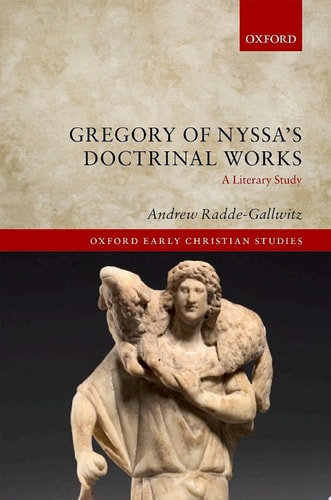
Gregory of Nyssa's Doctrinal Works: A Literary Study
0
0
As an Amazon Associate and affiliate partner, Menrva Books earns from qualifying purchases. Learn more
Author Description
Gregory of Nyssa is firmly established in today's theological curriculum and is a major figure in the study of late antiquity. Students encounter him in anthologies of primary sources, in surveys of Christian history and perhaps in specialized courses on the doctrine of the Trinity, eschatology, asceticism, or the like. Gregory of Nyssa's Doctrinal Works presents a reading of the works in Gregory's corpus devoted to the dogmatic controversies of his day. Andrew Radde-Gallwitz focuses as much on Gregory the writer as on Gregory the dogmatic theologian. He sets both elements not only within the context of imperial legislation and church councils of Gregory's day, but also within their proper religious context-that is, within the temporal rhythms of ritual and sacramental practice. Gregory himself roots what we call Trinitarian theology within the church's practice of baptism. In his dogmatic treatises, where textbook accounts might lead one to expect much more on the metaphysics of substance or relation, one finds a great deal on baptismal grace; in his sermons, reflecting on the occasion of baptism tends to prompt Trinitarian questions.
Menrva's Summary
THE THESIS
How does the intersection of ritual practice and dogmatic theology define the literary and doctrinal output of Gregory of Nyssa? Andrew Radde-Gallwitz, a scholar of early Christian thought, examines Gregory's corpus by bridging the gap between abstract theological metaphysics and the lived experience of the fourth-century church. He argues that Gregory's Trinitarian theology is not merely a product of intellectual debate but is deeply embedded in the liturgical and sacramental life of the Christian community, specifically the practice of baptism.
THE SCOPE MAP
What You Will Find
- Analysis of Gregory of Nyssa's dogmatic treatises and sermons.
- Examination of the relationship between imperial legislation, church councils, and theological writing.
- Investigation into the role of baptismal grace as a foundational element of Nyssan Trinitarianism.
Scope Limits
- The study does not provide a comprehensive biography of Gregory of Nyssa.
- The text does not focus on Gregory's ascetic writings outside of their relation to his dogmatic framework.
THE AUTHORITY PERSPECTIVE
Scholars recognize this work as a significant contribution to the study of late antiquity, particularly for its focus on the literary dimensions of patristic theology. Readers frequently note the academic density of the prose, which is intended for students and researchers of early Christian history and doctrine.
Page Count:
336
Publication Date:
2018-01-01
Publisher:
OUP Oxford
ISBN-10:
0192536125
ISBN-13:
9780192536129
Philosophy
Religion
Patristics
Theology
Late Antiquity
Theology doctrinal
Christian History
Community Tags
Similar Books