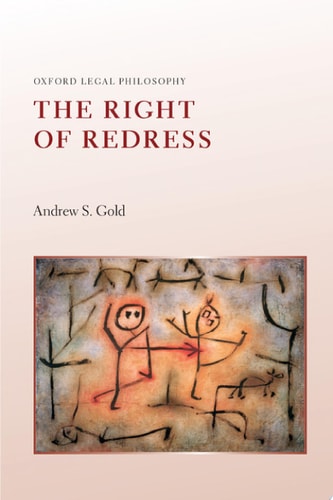
The Right of Redress
0
0
As an Amazon Associate and affiliate partner, Menrva Books earns from qualifying purchases. Learn more
Author Description
The law enables private parties to undo the wrongs committed against them, allowing victims to seek redress. A distinctive kind of justice governs our legal rights of redress, different from the leading corrective justice approaches. Through analysis of this key idea, The Right of Redress helps to make sense of tort, contract, fiduciary law, and unjust enrichment doctrine. When a wrong is remedied, the authorship of that remedy matters. The justice in private law is sensitive to a right holder's authorship, and understanding how solves a number of legal theory puzzles. Many forms of redress are only available with state assistance, and a full account of private law requires an account of the state's responsibility to assist. It also requires an explanation of those cases in which the state declines to assist. Prior accounts have drawn on Kantian principles or a Lockean social contract theory, where The Right of Redress, drawing on public fiduciary theory, develops a distinctive account of the state's role. This book offers a new take on various modern features of the private law landscape, ranging from equity, to damage caps, to arbitration, to corporate claims, to class actions. The Right of Redress thus offers a pathbreaking account of the justice in private law, the political theory that underlies it, and the contemporary features that shape our rights of redress today.
Menrva's Summary
THE THESIS
This book investigates the nature of private law justice by examining the specific mechanisms through which victims obtain redress for wrongs committed against them. Andrew S. Gold, a scholar of private law and legal theory, utilizes a public fiduciary framework to challenge existing corrective justice models. He argues that the authorship of a remedy is central to legal justice and that the state holds a specific responsibility to assist in the realization of these rights.
THE SCOPE MAP
What You Will Find
- A public fiduciary theory of private law
- Analysis of tort, contract, fiduciary law, and unjust enrichment
- Examination of modern legal features including equity, damage caps, and class actions
Scope Limits
- Does not provide a comprehensive history of common law development
- Does not focus on criminal law or public law outside the context of private redress
THE AUTHORITY PERSPECTIVE
Legal scholars view this work as a significant contribution to the ongoing debate regarding the political foundations of private law. Readers frequently note the high level of academic rigor and the author's success in synthesizing complex philosophical concepts with practical legal doctrine.
Page Count:
250
Publication Date:
2020-01-01
Publisher:
OUP Oxford
ISBN-10:
0192545582
ISBN-13:
9780192545589
Law
Private Law
Jurisprudence
Political Theory
Professional Career & Trade