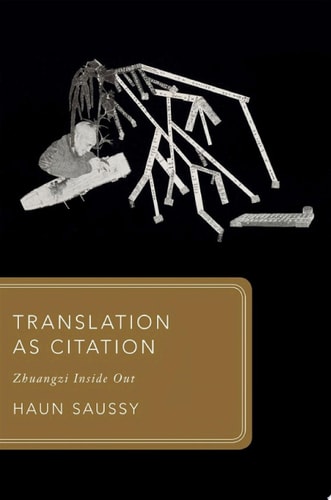
Translation as Citation: Zhuangzi Inside Out
0
0
As an Amazon Associate and affiliate partner, Menrva Books earns from qualifying purchases. Learn more
Author Description
This volume examines translation from many different angles: it explores how translations change the languages in which they occur, how works introduced from other languages become part of the consciousness of native speakers, and what strategies translators must use to secure acceptance for foreign works. Haun Saussy argues that translation doesn't amount to the composition, in one language, of statements equivalent to statements previously made in another language. Rather, translation works with elements of the language and culture in which it arrives, often reconfiguring them irreversibly: it creates, with a fine disregard for precedent, loan-words, calques, forced metaphors, forged pasts, imaginary relationships, and dialogues of the dead. Creativity, in this form of writing, usually considered merely reproductive, is the subject of this book. The volume takes the history of translation in China, from around 150 CE to the modern period, as its source of case studies. When the first proponents of Buddhism arrived in China, creativity was forced upon them: a vocabulary adequate to their purpose had yet to be invented. A Chinese Buddhist textual corpus took shape over centuries despite the near-absence of bilingual speakers. One basis of this translating activity was the rewriting of existing Chinese philosophical texts, and especially the most exorbitant of all these, the collection of dialogues, fables, and paradoxes known as the Zhuangzi. The Zhuangzi also furnished a linguistic basis for Chinese Christianity when the Jesuit missionary Matteo Ricci arrived in the later part of the Ming dynasty and allowed his friends and associates to frame his teachings in the language of early Daoism. It would function as well when Xu Zhimo translated from The Flowers of Evil in the 1920s. The chance but overdetermined encounter of Zhuangzi and Baudelaire yielded a 'strange music' that retroactively echoes through two millennia of Chinese translation, outlining a new understan
Menrva's Summary
THE THESIS
How does the act of translation fundamentally reconfigure the target language and culture rather than merely reproducing original statements? Haun Saussy, a professor of comparative literature, challenges the traditional view of translation as a simple act of equivalence. By analyzing historical case studies from China, he argues that translation is a creative, transformative process that forces new vocabularies, metaphors, and cultural relationships into existence.
THE SCOPE MAP
What You Will Find
- Historical analysis of translation in China from 150 CE to the modern era.
- Examination of the Buddhist textual corpus and its reliance on existing Chinese philosophical frameworks.
- Case studies on the integration of the Zhuangzi into Jesuit Christian teachings and 20th-century literary translations.
- Theoretical exploration of loan-words, calques, and the invention of linguistic precedents.
Scope Limits
- The book does not provide a comprehensive history of all Chinese translation practices.
- It does not offer a practical manual for professional translators seeking standardized techniques.
THE AUTHORITY PERSPECTIVE
Scholars in the field of comparative literature and translation studies recognize this work as a sophisticated intervention in how we understand cross-cultural linguistic exchange. Readers frequently note the academic density of the prose, which demands a high level of familiarity with both translation theory and Chinese intellectual history.
Page Count:
168
Publication Date:
2017-01-01
Publisher:
OUP Oxford
ISBN-10:
0192540637
ISBN-13:
9780192540638
Philosophy
Literary Criticism
Translating and interpreting
English
Comparative
English & College Success
History of Ideas
Asian Studies
Translation Studies
Community Tags
Similar Books