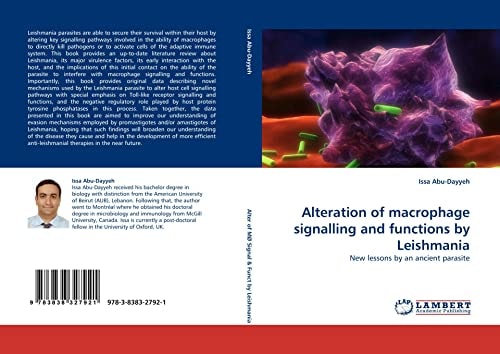
Alteration of Macrophage Signalling and Functions by Leishmania: New Lessons by an Ancient Parasite
0
0
As an Amazon Associate and affiliate partner, Menrva Books earns from qualifying purchases. Learn more
Author Description
Leishmania parasites are able to secure their survival within their host by altering key signalling pathways involved in the ability of macrophages to directly kill pathogens or to activate cells of the adaptive immune system. This book provides an up-to-date literature review about Leishmania, its major virulence factors, its early interaction with the host, and the implications of this initial contact on the ability of the parasite to interfere with macrophage signalling and functions. Importantly, this book provides original data describing novel mechanisms used by the Leishmania parasite to alter host cell signalling pathways with special emphasis on Toll-like receptor signalling and functions, and the negative regulatory role played by host protein tyrosine phosphatases in this process. Taken together, the data presented in this book are aimed to improve our understanding of evasion mechanisms employed by promastigotes and/or amastigotes of Leishmania, hoping that such findings will broaden our understanding of the disease they cause and help in the development of more efficient anti-leishmanial therapies in the near future.
Menrva's Summary
THE THESIS
This book investigates how Leishmania parasites manipulate host macrophage signaling to ensure their survival and proliferation. The author, Issa Abu-Dayyeh, reviews current literature on Leishmania, detailing its virulence factors, initial host interactions, and the subsequent interference with macrophage signaling pathways. The work presents original data on novel mechanisms employed by the parasite, particularly focusing on Toll-like receptor signaling and the role of host protein tyrosine phosphatases in negative regulation. Ultimately, the book aims to deepen the understanding of Leishmania's evasion strategies to inform the development of more effective anti-leishmanial therapies.
THE SCOPE MAP
- A comprehensive literature review on Leishmania parasites and their interaction with host macrophages.
- Detailed examination of major Leishmania virulence factors.
- Analysis of the early stages of host-parasite interaction and its impact on immune response.
- Original data on novel mechanisms of host cell signaling pathway alteration by Leishmania.
- Special emphasis on Toll-like receptor signaling and macrophage functions.
- Discussion of the negative regulatory role of host protein tyrosine phosphatases in Leishmania infection.
- Insights into evasion mechanisms employed by both promastigote and amastigote forms of Leishmania.
THE AUTHORITY PERSPECTIVE
This book offers a detailed exploration of the complex interplay between Leishmania parasites and the host immune system, specifically focusing on macrophage signaling. The inclusion of original data on parasite evasion mechanisms, particularly concerning Toll-like receptor signaling and protein tyrosine phosphatases, provides novel insights for researchers. The work is structured to enhance understanding of Leishmania's survival strategies, with the ultimate goal of contributing to the development of improved therapeutic interventions against leishmaniasis. The comprehensive review of existing literature, combined with new findings, positions this book as a valuable resource for the scientific community.
Page Count:
256
Publication Date:
2010-09-14
Publisher:
LAP LAMBERT Academic Publishing
ISBN-10:
3838327926
ISBN-13:
9783838327921
Non-Fiction
Science
Infectious Diseases
Immunology
Parasitology
Community Tags
Similar Books