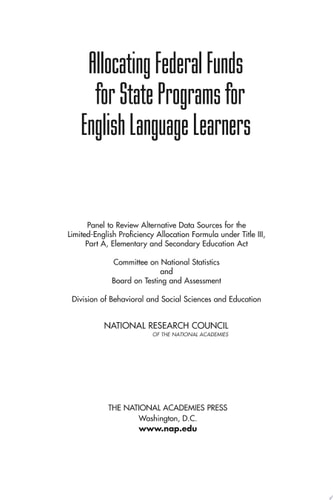
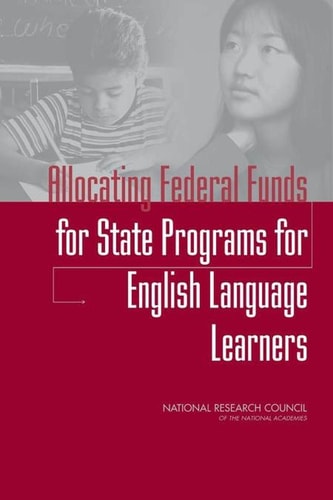
Allocating Federal Funds for State Programs for English Language Learners
0
0
As an Amazon Associate and affiliate partner, Menrva Books earns from qualifying purchases. Learn more
Author Description
As the United States continues to be a nation of immigrants and their children, the nation's school systems face increased enrollments of students whose primary language is not English. With the 2001 reauthorization of the Elementary and Secondary Education Act (ESEA) in the No Child Left Behind Act (NCLB), the allocation of federal funds for programs to assist these students to be proficient in English became formula-based: 80 percent on the basis of the population of children with limited English proficiency1 and 20 percent on the basis of the population of recently immigrated children and youth. Title III of NCLB directs the U.S. Department of Education to allocate funds on the basis of the more accurate of two allowable data sources: the number of students reported to the federal government by each state education agency or data from the American Community Survey (ACS). The department determined that the ACS estimates are more accurate, and since 2005, those data have been basis for the federal distribution of Title III funds. Subsequently, analyses of the two data sources have raised concerns about that decision, especially because the two allowable data sources would allocate quite different amounts to the states. In addition, while shortcomings were noted in the data provided by the states, the ACS estimates were shown to fluctuate between years, causing concern among the states about the unpredictability and unevenness of program funding. In this context, the U.S. Department of Education commissioned the National Research Council to address the accuracy of the estimates from the two data sources and the factors that influence the estimates. The resulting book also considers means of increasing the accuracy of the data sources or alternative data sources that could be used for allocation purposes.
Menrva's Summary
THE THESIS
This book investigates the complexities and controversies surrounding the allocation of federal funds for English Language Learner programs in U.S. states. The U.S. Department of Education uses a formula based on the American Community Survey (ACS) to distribute Title III funds, a decision that has drawn criticism due to differing allocation amounts compared to state-reported data. This report examines the accuracy of both data sources, the factors influencing their estimates, and proposes potential improvements or alternative data sources to ensure more predictable and equitable funding for these crucial educational programs.
THE SCOPE MAP
- Analysis of the accuracy of two primary data sources for allocating federal funds: state-reported student data and the American Community Survey (ACS).
- Examination of the factors that influence the estimates derived from both data sources.
- Discussion of the implications of using ACS data versus state-reported data on fund allocation to different states.
- Consideration of the concerns raised by states regarding the unpredictability and unevenness of program funding due to ACS data fluctuations.
- Exploration of potential means to increase the accuracy of existing data sources.
- Investigation of alternative data sources that could be utilized for more reliable fund allocation.
- Contextualization within the framework of the Elementary and Secondary Education Act (ESEA) and the No Child Left Behind Act (NCLB).
THE AUTHORITY PERSPECTIVE
This report is a technical examination commissioned by the U.S. Department of Education to address specific concerns regarding federal fund allocation for English Language Learner programs. The analysis focuses on the comparative accuracy of the American Community Survey (ACS) and state-reported data, as well as the implications of these choices for state funding. The work aims to provide a data-driven perspective to inform policy decisions and improve the predictability and equity of financial support for these educational initiatives.
Page Count:
240
Publication Date:
2011-07-20
Publisher:
National Academies Press
ISBN-10:
0309186587
ISBN-13:
9780309186582
Politics
Economics
Non-Fiction
Research
Education
Policy
Sociology
Government
Community Tags
Other Editions(2)
Similar Books










Reader Comments
Share Your Thoughts
No comments yet. Be the first to share your thoughts!