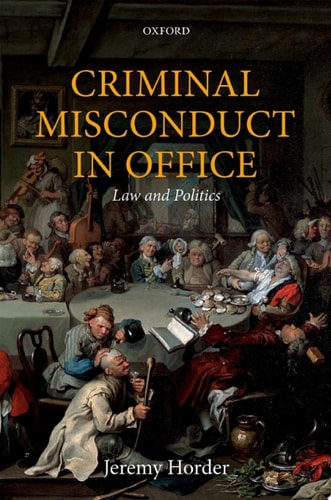
Criminal Misconduct in Office: Law and Politics
0
0
As an Amazon Associate and affiliate partner, Menrva Books earns from qualifying purchases. Learn more
Author Description
Should the criminal law be used to deter and punish corruption in politics: from employing family members at public expense to improper spending on elections, lobbying, and cronyism? How did so many MPs avoid facing charges after the 2009 government expenses scandal? In this book, Jeremy Horder tackles these questions and more. As well as offering the first treatment of the history, philosophy, and politics of the application of the offence of misconduct in office to Members of Parliament in England and Wales, Horder explains how political corruption might be dealt with in future, and how politicians could be held accountable for their actions so that they are deterred from betraying the public's trust. Use of the criminal law should not be the sole or even the main way to remedy all corruption in politics. Nevertheless, for too long the offence of misconduct in a public office has had an ambiguous status in the political realm. If we are to preserve the good health of government it must be seen as a constitutional fundamental. A charge of misconduct provides a way in which corrupt conduct on the part of legislators can be punished with an appropriate label, holding them to account for the misuse of power by reference to the standards of ordinary people. When other - civil law or regulatory - means prove insufficient, it should be possible for ordinary members of a jury, and not for Parliamentarians or other officials, to decide whether, for example, the expenditure of public money on legislators' private income and benefits amounts to a criminal abuse of the public's trust. This book offers an authoritative and accessible account of a 'bottom-up' (jury standards-led), as opposed to a 'top-down' (officials applying their own standards), approach to the role of the criminal law in constitutional contexts.
Menrva's Summary
THE THESIS
This book investigates the role and legitimacy of the criminal offense of misconduct in public office as a mechanism for holding political figures accountable for corruption. Jeremy Horder, a professor of criminal law, utilizes historical analysis, legal philosophy, and political theory to argue that the criminal law serves as a necessary constitutional safeguard. He posits that when regulatory or civil mechanisms fail, the criminal justice system provides a vital, jury-led method for enforcing public standards of conduct among legislators.
THE SCOPE MAP
What You Will Find
- Historical and philosophical development of misconduct in public office as a legal charge
- Analysis of the 2009 UK government expenses scandal and its legal aftermath
- A framework for a 'bottom-up' approach to accountability using jury-based standards
- Comparative discussion on the limits of criminal law versus civil or regulatory oversight
Scope Limits
- The analysis is primarily focused on the legal system of England and Wales
- The text does not provide a comprehensive manual for prosecuting all forms of political corruption
THE AUTHORITY PERSPECTIVE
Legal scholars and practitioners recognize this work as a significant contribution to the discourse on constitutional accountability and criminal law. Readers frequently note the academic rigor and the clarity with which Horder navigates the intersection of political ethics and judicial practice.
Page Count:
224
Publication Date:
2018-01-01
Publisher:
OUP Oxford
ISBN-10:
0192556886
ISBN-13:
9780192556882
Public Policy
Law
Professional Career & Trade
Constitutional Law
Misconduct In Office
Community Tags
Similar Books