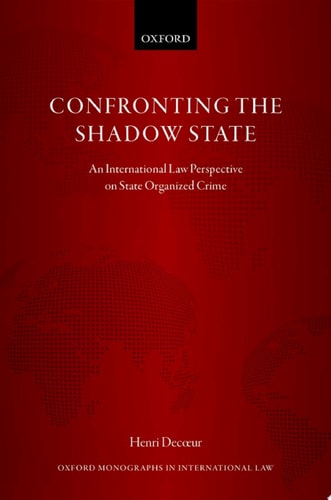
Confronting the Shadow State: An International Law Perspective on State Organized Crime
0
0
As an Amazon Associate and affiliate partner, Menrva Books earns from qualifying purchases. Learn more
Author Description
This book examines the rules and mechanisms of international law relevant to the suppression of state organized crime, and provides a normative justification for developing international legal mechanisms specifically designed to address this phenomenon. State organized crime refers to the use by senior state officials of the resources of the state to facilitate or participate in organized crime, in pursuit of policy objectives or personal profit. This concept covers diverse forms of government misconduct, including strategic partnerships with drug traffickers, the plundering of a country's resources by kleptocrats, and high-level corruption schemes. The book identifies the distinctive criminological characteristics of state organized crime, and analyses the applicability, potential, and limits of the norms and mechanisms of international law relevant to the suppression of state organized crime. In particular, it discusses whether the involvement of state organs or agents in organized crime may amount to an internationally wrongful act giving rise to the international responsibility of the state, and highlights a number of practical and normative shortcomings of the legal framework established by relevant crime-suppression conventions. The book also sketches proposals to develop an international legal framework designed to hold perpetrators of state organized crime accountable. It presents a normative justification for criminalizing and suppressing state organized crime at the international level, proposes draft provisions for an international convention for the suppression of state organized crime, and discusses the potential role of the UN Security Council and of international criminal courts and tribunals, respectively, in holding perpetrators accountable. Providing the first comprehensive analysis, from the perspective of international law, of a phenomenon so far mainly studied by criminologists, this study would appeal to researchers, social activists, and policymakers.
Menrva's Summary
THE THESIS
This book investigates the adequacy of current international legal frameworks in addressing the phenomenon of state organized crime, where government officials utilize state resources for illicit activities. Henri Decoeur, writing within the tradition of international legal scholarship, synthesizes criminological data with existing treaty law to argue for a more robust, specialized international convention. The work provides a normative justification for holding state actors accountable for corruption, resource plundering, and strategic criminal partnerships.
THE SCOPE MAP
What You Will Find
- Analysis of international responsibility for state-sponsored wrongful acts
- Evaluation of existing crime-suppression conventions and their practical limitations
- Proposed draft provisions for a new international convention on state organized crime
- Discussion of the roles of the UN Security Council and international criminal tribunals
Scope Limits
- Does not provide a comprehensive history of every specific instance of state crime
- Does not focus on domestic criminal law procedures outside of their international implications
THE AUTHORITY PERSPECTIVE
Experts identify this work as a foundational text for bridging the gap between criminological theory and international legal practice. Readers frequently note the academic density of the prose, which makes it a specialized resource for legal scholars and policy practitioners.
Page Count:
299
Publication Date:
2018-01-01
Publisher:
OUP Oxford
ISBN-10:
0192557203
ISBN-13:
9780192557209
Law
Human rights
Governance
Professional Career & Trade
International Law
Criminology
Community Tags
Similar Books