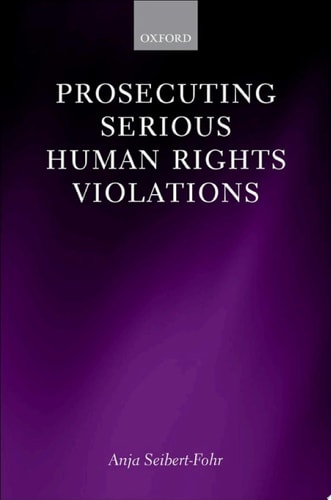
Prosecuting Serious Human Rights Violations
0
0
As an Amazon Associate and affiliate partner, Menrva Books earns from qualifying purchases. Learn more
Author Description
Criminal punishment is increasingly seen as a necessary element of human rights protection. There is a growing conviction at the international level that those responsible for the most serious crimes should not go unpunished. Although there is a wealth of legal writing on international criminal law, an extensive analysis is still needed of the questions why and to what extent criminal prosecution is a necessary means of human rights protection at the domestic level. This book is the first to examine comprehensively the duty to prosecute serious human rights violations under the International Covenant on Civil and Political Rights, the American and European Conventions on Human Rights, and customary international law. It does so by exploring the phenomena of impunity and amnesties. These issues are particularly relevant for post-conflict situations in which it is often argued that criminal punishment threatens peace and reconciliation. The question of how to deal with post-conflict justice under international human rights law is therefore a continuing theme throughout the book. Apart from post-conflict justice the text also considers the relevance of criminal measures in times of peace by exposing flaws in the criminal legislation and in the conduct of criminal procedure. With its survey of the relevant human rights instruments and jurisprudence, Prosecuting Serious Human Rights Violations is placed at the interface of international criminal law and international human rights. The book analyses the rapidly growing body of human rights case law, dealing with criminalization, prosecution and punishment of serious human rights violations. It identifies and critically examines the standards for the conduct of criminal proceedings developed by the European and Inter-American Courts of Human Rights and the UN Human Rights Committee, providing a unique reference tool for scholars and practitioners working in this area of law. It also describes the standards for criminal law
Menrva's Summary
THE THESIS
This book investigates the legal obligation of states to prosecute serious human rights violations under international law and the extent to which such prosecution is required for effective human rights protection. Anja Seibert-Fohr, a legal scholar, synthesizes international human rights instruments and jurisprudence to evaluate the tension between criminal accountability and post-conflict reconciliation. The work argues that criminal punishment serves as a fundamental mechanism for upholding human rights, even when challenged by political arguments for amnesty or peace-building.
THE SCOPE MAP
What You Will Find
- Analysis of the International Covenant on Civil and Political Rights, American and European Conventions on Human Rights, and customary international law.
- Examination of the phenomena of impunity and the legal status of amnesties.
- Evaluation of standards for criminal proceedings developed by the European and Inter-American Courts of Human Rights and the UN Human Rights Committee.
Scope Limits
- The text focuses primarily on the intersection of international human rights law and domestic criminal prosecution rather than the internal operations of international criminal tribunals like the ICC.
THE AUTHORITY PERSPECTIVE
Legal scholars and practitioners identify this work as a foundational reference for understanding the intersection of human rights law and domestic criminal justice. The text is noted for its rigorous analysis of case law and its utility in navigating the complex standards governing state obligations in post-conflict and peacetime environments.
Page Count:
363
Publication Date:
2009-01-01
Publisher:
OUP Oxford
ISBN-10:
0191610003
ISBN-13:
9780191610004
Law
Human rights
International Law
Trials
Criminal Law
Prosecution
Professional Career & Trade
Community Tags
Other Editions(4)

Similar Books






Reader Comments
Share Your Thoughts
No comments yet. Be the first to share your thoughts!