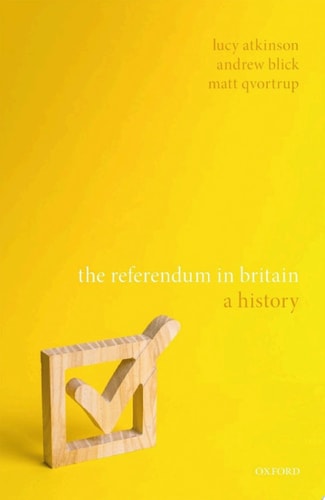
The Referendum in Britain: A History
0
0
As an Amazon Associate and affiliate partner, Menrva Books earns from qualifying purchases. Learn more
Author Description
The European Union referendum of 23 June 2016 proved to be the trigger for the most prolonged period of political turbulence in the peacetime history of the UK; leading to major policy changes and realignments in the party-political system. This book considers from an historical perspective the democratic device that provided the focus for this upheaval. Beginning in the late nineteenth century, it discusses how the idea of using referendums to resolve major political disputes first came onto the agenda, and why. It considers who advocated it, and in what circumstances. The book describes how referendums eventually came into use from the 1970s onwards, and the different patterns in their deployment in the decades that have followed. Major political figures, from Herbert Henry Asquith and Winston Churchill to Clement Attlee, Harold Wilson and Margaret Thatcher; to Tony Blair, David Cameron, and Boris Johnson form part of the story. Governments have come to power and fallen in the context of demands for referendums or the results they produced. The authors provide detailed accounts of each of the 13 major referendums that have taken place. Referendums took place at UK and sub-UK level. They were held on the position of Northern Ireland (1973) and Scotland (2014) within the UK; on devolution to Wales (1979; 1997; 2011) and Scotland (1979; 1979); on the Belfast/Good Friday Agreement (1998); on devolution to London (1998) and North East England (2004); on the parliamentary voting system (2011); and on UK participation in European integration (1975; 1975). The book provides a constitutional and international perspective, and ask how far the original ideas lying behind the referendum were fulfilled in practice.
Menrva's Summary
THE THESIS
This book investigates the historical evolution and practical application of the referendum as a democratic instrument within the United Kingdom. The authors, Andrew Blick, Lucy Jo Atkinson, and Matt Qvortrup, utilize a constitutional and historical framework to analyze how the referendum moved from a fringe political idea in the late nineteenth century to a central, often disruptive, feature of modern British governance. By examining the motivations of political leaders and the outcomes of specific votes, the text evaluates whether the original democratic intentions behind these referendums were realized in practice.
THE SCOPE MAP
What You Will Find
- A chronological analysis of the referendum device from the late nineteenth century to the present day.
- Detailed accounts of 13 major referendums held at both the UK and sub-UK levels.
- An examination of the impact of referendums on party-political systems and government stability.
Scope Limits
- The text focuses primarily on the constitutional and political history of the UK rather than comparative international referendum theory.
- It does not provide an exhaustive analysis of every minor local plebiscite or non-binding consultative poll.
THE AUTHORITY PERSPECTIVE
Experts recognize this work as a comprehensive historical record of the referendum in British political life. Readers frequently note the academic rigor and the clarity with which the authors connect historical precedents to contemporary political turbulence.
Page Count:
253
Publication Date:
2020-01-01
Publisher:
OUP Oxford
ISBN-10:
0192556711
ISBN-13:
9780192556714
History
British Politics
Constitutional Law
Government
Community Tags
Other Editions(2)
Similar Books

Reader Comments
Share Your Thoughts
No comments yet. Be the first to share your thoughts!