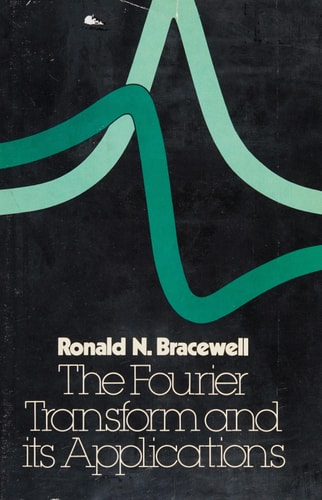
Fourier Transform and Its Applications, 2nd Edition (McGraw-Hill electrical and electronic engineering series)
0
0
As an Amazon Associate and affiliate partner, Menrva Books earns from qualifying purchases. Learn more
Author Description
This text is designed for use in a senior undergraduate or graduate level course in Fourier Transforms. This text differs from many other fourier transform books in its emphasis on applications. Bracewell applies mathematical concepts to the physical world throughout this text, equipping students to think about the world and physics in terms of transforms. The pedagogy in this classic text is excellent. The author has included such tools as the pictorial dictionary of transforms and bibliographic references. In addition, there are many excellent problems throughout this book, which are more than mathematical exercises, often requiring students to think in terms of specific situations or asking for educated opinions. To aid students further, discussions of many of the problems can be found at the end of the book.
Menrva's Summary
THE THESIS
This text investigates the practical application of Fourier transforms as a fundamental analytical tool for understanding physical phenomena. Ronald Newbold Bracewell, a prominent figure in radio astronomy and signal processing, leverages his expertise to bridge the gap between abstract mathematical theory and real-world engineering problems. The book utilizes a pedagogical framework that prioritizes physical intuition, encouraging students to interpret complex systems through the lens of transform theory rather than rote calculation.
THE SCOPE MAP
What You Will Find
- Comprehensive coverage of Fourier transform theory and its mathematical properties
- A pictorial dictionary of transforms for visual reference
- Extensive problem sets designed to test conceptual understanding rather than mere computation
- Bibliographic references for further academic inquiry
Scope Limits
- The text assumes a background in undergraduate-level mathematics and physics
- It does not focus on purely theoretical or abstract mathematical proofs without physical context
THE AUTHORITY PERSPECTIVE
Experts and educators frequently cite this work as a foundational text for students in electrical engineering and physics. Readers often note the clarity of the author's pedagogical approach and the utility of the included problem sets in developing practical analytical skills.
Page Count:
444
Publication Date:
1978-01-01
Publisher:
McGraw-Hill
ISBN-10:
007007013X
ISBN-13:
9780070070134
Mathematics
Physics
Engineering
textbook
Science & Math
Community Tags
Similar Books