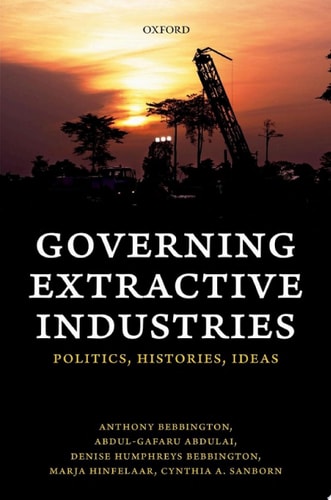
Governing Extractive Industries: Politics, Histories, Ideas
0
0
As an Amazon Associate and affiliate partner, Menrva Books earns from qualifying purchases. Learn more
Author Description
This is an open access title available under the terms of a CC BY-NC-ND 4.0 International licence. It is free to read at Oxford Scholarship Online and offered as a free PDF download from OUP and selected open access locations. Proposals for more effective natural resource governance emphasize the importance of institutions and governance, but say less about the political conditions under which institutional change occurs. Governing Extractive Industries synthesizes findings regarding the political drivers of institutional change in extractive industry governance. It analyses resource governance from the late nineteenth century to the present in Bolivia, Ghana, Peru, and Zambia, focusing on the ways in which resource governance and national political settlements interact. The authors focus on the ways in which resource governance and national political settlements interact, exploring the nature of elite politics, the emergence of new political actors, forms of political contention, changing ideas regarding natural resources and development, the geography of natural resource deposits, and the influence of the transnational political economy of global commodity production.
Menrva's Summary
THE THESIS
This work investigates the political conditions and institutional drivers that shape the governance of extractive industries across diverse national contexts. The authors, a team of scholars specializing in political economy and development, synthesize historical and contemporary data to argue that resource governance is inextricably linked to national political settlements. By examining the interplay between elite politics, transnational economic forces, and domestic institutional change, the text provides a framework for understanding why governance reforms succeed or fail in resource-rich nations.
THE SCOPE MAP
What You Will Find
- Comparative analysis of extractive industry governance in Bolivia, Ghana, Peru, and Zambia.
- Historical longitudinal study spanning from the late nineteenth century to the present.
- Examination of the influence of global commodity production on national political settlements.
Scope Limits
- The analysis does not provide a universal blueprint for policy reform.
- The text focuses primarily on political and institutional drivers rather than technical engineering or geological aspects of extraction.
THE AUTHORITY PERSPECTIVE
Experts identify this text as a significant contribution to the field of political economy, particularly for its focus on the intersection of national politics and resource management. Readers frequently note the academic density of the prose and the rigorous comparative methodology employed by the authors.
Page Count:
290
Publication Date:
2018-01-01
Publisher:
OUP Oxford
ISBN-10:
0192552899
ISBN-13:
9780192552891
History
Economics
Mining law
Natural Resources
International relations
Community Tags
Similar Books