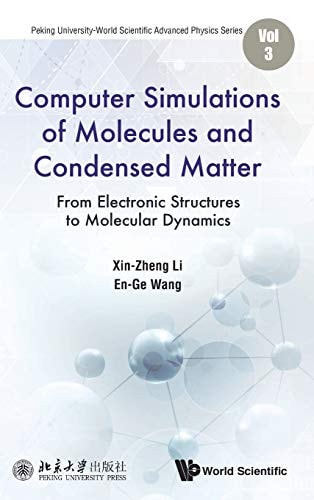
Computer Simulations of Molecules and Condensed Matter: From Electronic Structures to Molecular Dynamics
0
0
As an Amazon Associate and affiliate partner, Menrva Books earns from qualifying purchases. Learn more
Author Description
This book provides a relatively complete introduction to the methods used in computational condensed matter. A wide range of electronic structure theories are introduced, including traditional quantum chemistry methods, density functional theory, many-body perturbation theory, and more. Molecular dynamics simulations are also discussed, with extensions to enhanced sampling and free-energy calculation techniques including umbrella sampling, meta-dynamics, integrated tempering sampling, etc. As a further extension beyond the standard Born-Oppenheimer molecular dynamics, some simulation techniques for the description of quantum nuclear effects are also covered, based on Feynman's path-integral representation of quantum mechanics. The book aims to help beginning graduate students to set up a framework of the concepts they should know before tackling the physical/chemical problems they will face in their research.
Menrva's Summary
THE THESIS
This book introduces computational methods for simulating molecules and condensed matter, bridging electronic structure theories with molecular dynamics. It covers a broad spectrum of electronic structure theories, from traditional quantum chemistry to advanced many-body perturbation theory and density functional theory. The text also details molecular dynamics simulations, including enhanced sampling techniques and free-energy calculations. Furthermore, it explores methods for describing quantum nuclear effects using Feynman's path-integral representation, aiming to equip graduate students with foundational knowledge for their research.
THE SCOPE MAP
- Introduction to traditional quantum chemistry methods
- Density Functional Theory (DFT) explained
- Many-body perturbation theory concepts
- Molecular dynamics simulations
- Enhanced sampling techniques (umbrella sampling, meta-dynamics, integrated tempering sampling)
- Free-energy calculation methods
- Simulation techniques for quantum nuclear effects
- Application of Feynman's path-integral representation
THE AUTHORITY PERSPECTIVE
The book is designed as an introductory text for beginning graduate students, aiming to provide a solid conceptual framework for computational condensed matter research. Its comprehensive coverage of electronic structure theories and molecular dynamics techniques, including advanced sampling and quantum nuclear effects, suggests it serves as a valuable resource for those entering the field. The inclusion of methods like DFT and path-integral simulations indicates a focus on modern computational approaches. The text likely offers a rigorous yet accessible overview for students needing to establish a strong foundation before engaging in specialized research problems.
Page Count:
263
Publication Date:
2018-01-01
Publisher:
World Scientific Publishing Company Pte Limited
ISBN-10:
9813230444
ISBN-13:
9789813230446
Science
Non-Fiction
Statistical mechanics
Computational Physics
Community Tags
Similar Books