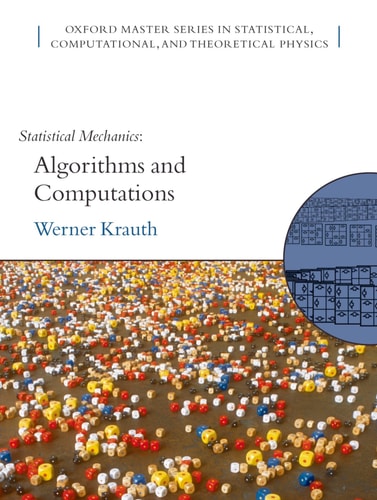
Statistical Mechanics: Algorithms and Computations
0
0
As an Amazon Associate and affiliate partner, Menrva Books earns from qualifying purchases. Learn more
Author Description
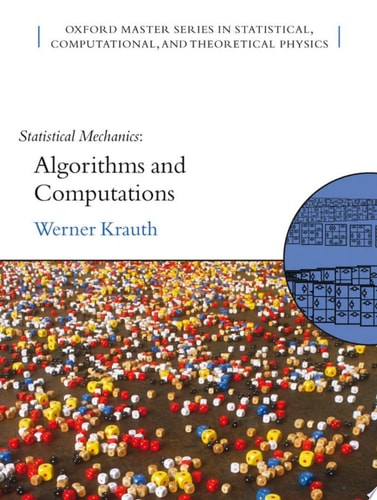
This book discusses the computational approach in modern statistical physics in a clear and accessible way and demonstrates its close relation to other approaches in theoretical physics. Individual chapters focus on subjects as diverse as the hard sphere liquid, classical spin models, single quantum particles and Bose-Einstein condensation. Contained within the chapters are in-depth discussions of algorithms, ranging from basic enumeration methods to modern Monte Carlo techniques. The emphasis is on orientation, with discussion of implementation details kept to a minimum. Illustrations, tables and concise printed algorithms convey key information, making the material very accessible. The book is completely self-contained and graphs and tables can readily be reproduced, requiring minimal computer code. Most sections begin at an elementary level and lead on to the rich and difficult problems of contemporary computational and statistical physics. The book will be of interest to a wide range of students, teachers and researchers in physics and the neighbouring sciences. An accompanying CD allows incorporation of the book's content (illustrations, tables, schematic programs) into the reader's own presentations.
Menrva's Summary
THE THESIS
This text investigates the integration of computational algorithms into the study of modern statistical physics to bridge the gap between theoretical models and numerical simulation. Werner Krauth, a researcher in computational physics, utilizes a pedagogical framework that prioritizes conceptual orientation over exhaustive coding implementation. By focusing on the relationship between theoretical physics and algorithmic application, the book provides a structured approach to solving complex physical problems.
THE SCOPE MAP
What You Will Find
- Analysis of hard sphere liquids and classical spin models
- Examination of single quantum particles and Bose-Einstein condensation
- Detailed explanations of Monte Carlo techniques and enumeration methods
Scope Limits
- Does not provide extensive, low-level programming code for every implementation
- Does not cover advanced quantum field theory beyond the scope of statistical applications
THE AUTHORITY PERSPECTIVE
Experts and educators recognize this work as a foundational text for students and researchers seeking to understand the intersection of computation and statistical physics. Readers frequently note the clarity of the prose and the effectiveness of the provided illustrations in conveying complex algorithmic concepts.
Page Count:
342
Publication Date:
2006-01-01
Publisher:
OUP Oxford
ISBN-10:
0191523321
ISBN-13:
9780191523328
Science
Mathematical Physics
Statistical mechanics
Physics
Computational Physics
textbook
Earth Sciences