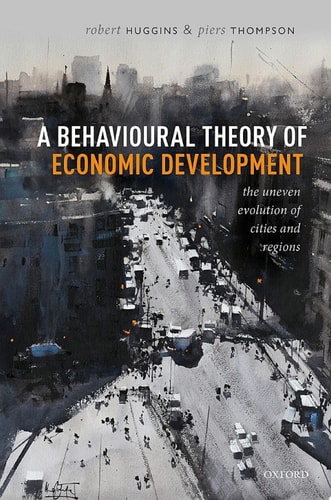
A Behavioural Theory of Economic Development: The Uneven Evolution of Cities and Regions
0
0
As an Amazon Associate and affiliate partner, Menrva Books earns from qualifying purchases. Learn more
Author Description
Innovation, entrepreneurship, knowledge, and human capital are widely acknowledged as key levers of development. Yet what are the sources of these factors, and why do they differ in their endowment across regions? Motivated by a belief that theories of economic development can move beyond the generally accepted explanations of location and the organization of industries and capital, this book establishes a behavioural theory of economic development illustrating that differences in human behaviour across cities and regions are a significant deep-rooted cause of uneven development. Fusing a range of concepts relating to culture, psychology, human agency, institutions, and power, it proposes that the long-term differentials in economic development between cities and regions, both within and across nations, is strongly connected to the underlying forms of behaviour enacted by humans on an individual and collective basis. Given a world of finite and limited resources, coupled with a rapidly growing population -- especially in cities and urban regions -- human behaviour, and the expectations and preferences upon which it is based, are central to understanding how notions of development may change in coming years. This book provides a novel theory of the role of psychocultural context and human behavioural and institutional frameworks in uneven economic development on a global scale.
Menrva's Summary
THE THESIS
This book investigates whether deep-rooted differences in human behavior across cities and regions serve as a primary driver of uneven economic development. Authors Robert Huggins and Piers Thompson, both established scholars in regional development and economic geography, argue that traditional models focusing solely on industry and capital location are insufficient. They propose a new framework that integrates psychology, culture, institutional theory, and human agency to explain why certain regions thrive while others stagnate.
THE SCOPE MAP
What You Will Find
- A theoretical framework linking psychocultural context to regional economic performance
- Analysis of how individual and collective human agency shapes institutional development
- Examination of the role of power dynamics in regional resource distribution
- Synthesis of concepts from behavioral economics, sociology, and geography
Scope Limits
- Does not provide a prescriptive policy manual for immediate economic growth
- Does not focus on micro-level individual psychological clinical studies
THE AUTHORITY PERSPECTIVE
Experts identify this work as a significant contribution to the field of regional science by bridging the gap between behavioral psychology and macro-economic development. Scholars frequently note the academic density of the prose, which is intended for researchers and students of economic geography and urban studies.
Page Count:
322
Publication Date:
2021-01-01
Publisher:
OUP Oxford
ISBN-10:
019256840X
ISBN-13:
9780192568403
Economics
Sociology
Urban Studies
Community Tags
Similar Books