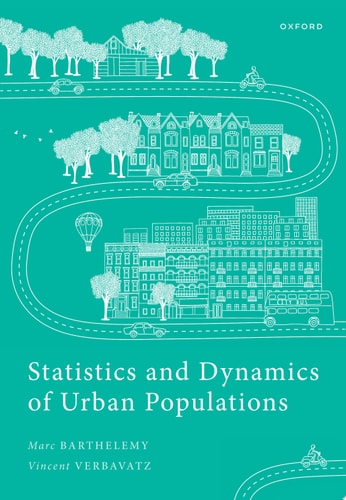
Statistics and Dynamics of Urban Populations: Empirical Results and Theoretical Approaches
0
0
As an Amazon Associate and affiliate partner, Menrva Books earns from qualifying purchases. Learn more
Author Description
Urbanization is a fundamental process in human history and is increasingly affecting our environment and society. Although cities have existed for centuries, describing and controlling urbanization has always been difficult and still is: cities are continuously changing over time in a non-homogeneous fashion that has puzzled historians, geographers, philosophers, economists, urbanists, engineers, mathematicians and physicists. In particular, one of the most debated issues of urban studies has been the question of urban population growth. How do cities appear and disappear, grow or decline? Why do we observe a hierarchy of cities from small to large and not a typical city size? These questions are not only relevant for census purposes. The population size of the city is an important determinant for most of urban issues: land management, congestion, public transport planning, economic growth, innovation incentives, food and good supply and climate-change adaptation. A sound understanding of population growth processes is an inescapable path for a good monitoring of city planning.This book describes all aspects of quantitative approaches to urban population growth, ranging from measures and empirical results to the mathematical description of their evolution. It will be of interest to researchers working on quantitative aspect of cities and from many different disciplines such as quantitative geography, spatial economics, geomatics, urbanism and transportation, physics, or applied mathematics. This book will also be of interest to graduate students and researchers entering the field or interested in quantitative studies of urban systems.
Menrva's Summary
THE THESIS
This book investigates the fundamental mechanisms governing urban population growth, seeking to explain why cities evolve in non-homogeneous patterns and how these dynamics shape the hierarchy of city sizes. The authors, Marc Barthelemy and Vincent Verbavatz, utilize a multidisciplinary framework that integrates empirical data with mathematical modeling to address the complexities of urban evolution. By synthesizing perspectives from geography, physics, and economics, they provide a rigorous analytical foundation for understanding how population size influences critical urban infrastructure and planning.
THE SCOPE MAP
What You Will Find
- Quantitative measures and empirical datasets regarding urban population evolution
- Mathematical models describing city growth, decline, and emergence
- Analysis of the relationship between city size and urban issues like congestion and economic output
Scope Limits
- The text focuses primarily on quantitative and mathematical modeling rather than qualitative sociological or historical narratives
- It does not provide prescriptive policy advice for specific city planning projects
THE AUTHORITY PERSPECTIVE
Experts recognize this work as a comprehensive technical resource for researchers and graduate students engaged in the quantitative study of urban systems. Readers frequently note the high level of mathematical rigor, making it a foundational text for those bridging the gap between urban geography and statistical physics.
Page Count:
176
Publication Date:
2024-01-01
Publisher:
Oxford University Press
ISBN-10:
0192867547
ISBN-13:
9780192867544
Economics
Sociology
Geography
Urban Studies
Mathematics
Physics
Community Tags
Similar Books