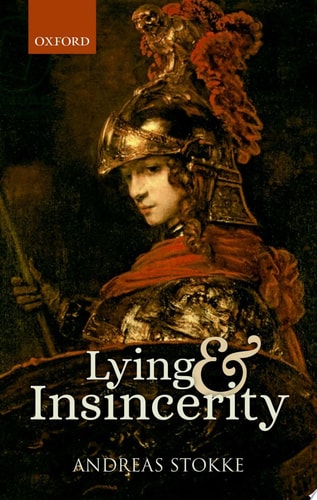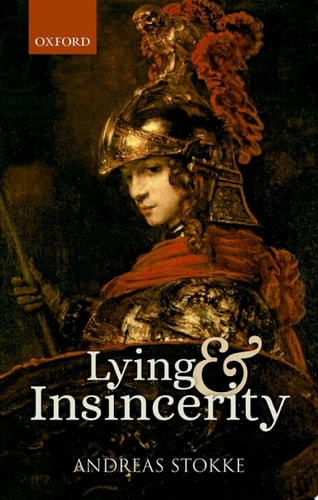
Lying and Insincerity
0
0
As an Amazon Associate and affiliate partner, Menrva Books earns from qualifying purchases. Learn more
Author Description
Andreas Stokke presents a comprehensive study of lying and insincere language use. He investigates how lying relates to other forms of insincerity and explores the kinds of attitudes that go with insincere uses of language. Part I develops an account of insincerity as a linguistic phenomenon. Stokke provides a detailed theory of the distinction between lying and speaking insincerely, and accounts for the relationship between lying and deceiving. A novel framework of assertion underpins the analysis of various kinds of insincere speech, including false implicature and forms of misleading with presuppositions, prosodic focus, and semantic incompleteness. Part II sets out the relationship between what is communicated and the speaker's attitudes. Stokke develops the view of insincerity as a shallow phenomenon that is dependent on conscious attitudes rather than deeper motivations. The various of ways of speaking while being indifferent toward what one communicates are covered, and the phenomenon of 'bullshitting' is distinguished from lying and other forms of insincerity. Finally, an account of insincere uses of interrogative, imperative, and exclamative utterances is also given.
Menrva's Summary
THE THESIS
This book investigates the linguistic and philosophical distinctions between lying, insincerity, and related communicative phenomena such as bullshitting. Andreas Stokke, a philosopher specializing in the philosophy of language, utilizes a formal framework of assertion to analyze how speakers convey information while maintaining indifferent or deceptive attitudes. He argues that insincerity is a shallow linguistic phenomenon rooted in conscious attitudes rather than complex psychological motivations.
THE SCOPE MAP
What You Will Find
- A formal theory distinguishing lying from general insincerity
- Analysis of false implicature, presuppositions, and prosodic focus
- A taxonomy of insincere speech acts including interrogatives, imperatives, and exclamatives
- A conceptual differentiation between lying and bullshitting
Scope Limits
- The text does not focus on the psychological or evolutionary origins of deception
- It does not provide a sociological study of lying in political or historical contexts
THE AUTHORITY PERSPECTIVE
Experts in the philosophy of language recognize this work as a rigorous contribution to the study of speech acts and communicative intent. Readers frequently note the technical density of the prose, which is intended for an academic audience familiar with formal semantics and pragmatics.
Page Count:
258
Publication Date:
2018-01-01
Publisher:
OUP Oxford
ISBN-10:
0192560352
ISBN-13:
9780192560353
Philosophy
Linguistics
Communication Studies
Truthfulness and falsehood
Philosophy of
Ethics