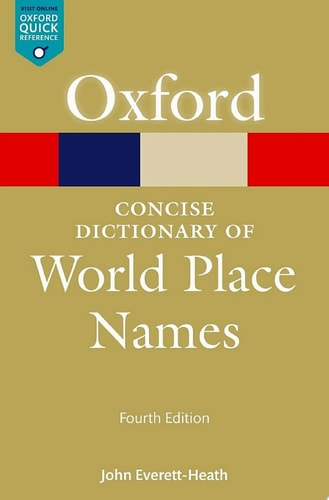
The Concise Dictionary of World Place-Names
0
0
As an Amazon Associate and affiliate partner, Menrva Books earns from qualifying purchases. Learn more
Author Description
There is no populated place without a name, and every name is chosen for a reason. This fascinating dictionary unveils the etymological roots and history of thousands of locations and landmarks from around the world. It contains over 11,000 entries, and covers an enormous range of country, region, island, city, town, mountain and river names from across the world, as well as the name in the local language. Place names are continually changing, and new names are adopted for many different reasons such as invasion, revolution, and decolonization. The Concise Dictionary of World Place-Names includes selected former names, and, where appropriate, some historical detail to explain the transition. The names of places often offer a real insight into the places themselves, revealing religious and cultural traditions, the migration of peoples, the ebb and flow of armies, the presence of explorers, local languages, industrial developments and topography. Superstition and legend can also play a part. This new edition has been updated to include over 750 new names, including Azincourt, Kropyvnyts'kyy, and Tlaxcala. It has also been edited to reflect socio-political and geographical shifts, notably the reorganisation of the French regions, and their consequent name alterations, as well as the decommunization of Ukrainian place-names. In addition to the entries themselves, the dictionary includes two appendices: a glossary of foreign word elements which appear in place-names and their meanings, and a list of personalities and leaders from all over the world who have influenced the naming of places.
Menrva's Summary
THE THESIS
This dictionary investigates the etymological origins and historical evolution of over 11,000 global place-names to reveal the cultural, political, and topographical factors that influence how locations are named. John Everett-Heath utilizes extensive linguistic and historical research to document how names reflect human migration, religious traditions, and socio-political shifts such as decolonization and revolution. The text serves as a comprehensive reference tool for understanding the naming conventions of countries, cities, and natural landmarks. By providing both current and former names, the author illustrates the fluid nature of geography and the impact of historical transitions on nomenclature.
THE SCOPE MAP
What You Will Find
- Over 11,000 entries covering global cities, regions, islands, mountains, and rivers.
- A glossary of foreign word elements frequently found in place-names.
- A list of historical figures and leaders who influenced the naming of specific locations.
Scope Limits
- The text does not provide exhaustive historical biographies for every location mentioned.
- It does not cover every minor village or hamlet, focusing instead on significant global landmarks and populated places.
THE AUTHORITY PERSPECTIVE
Experts and researchers frequently cite this work as a reliable and authoritative resource for toponymic study. Readers note the high density of information and the utility of the appendices for linguistic analysis.
Page Count:
1088
Publication Date:
2018-01-01
Publisher:
OUP Oxford
ISBN-10:
0192562436
ISBN-13:
9780192562432
History
Dictionaries
Etymology
Linguistics
English literature
Geography
Reference
Community Tags
Other Editions(3)
Similar Books










Reader Comments
Share Your Thoughts
No comments yet. Be the first to share your thoughts!