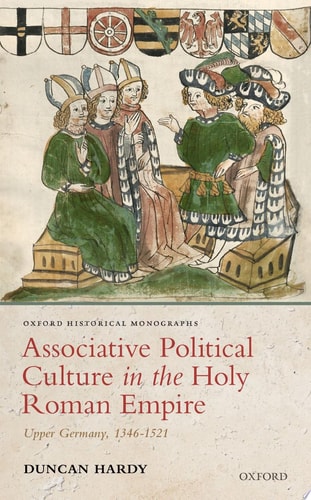
Associative Political Culture in the Holy Roman Empire
0
0
As an Amazon Associate and affiliate partner, Menrva Books earns from qualifying purchases. Learn more
Author Description
What Was The Holy Roman Empire In The Fourteenth To Sixteenth Centuries? At The Turning Point Between The Medieval And Early Modern Periods, This Vast Central European Polity Was The Continent's Most Politically Fragmented. The Imperial Monarchs Were Often Weak And Distant, While A Diverse Array Of Regional Actors Played An Autonomous Role In Political Life. The Empire's Obvious Differences Compared With More Centralized European Kingdoms Have Stimulated Negative Historical Judgements And Fraught Debates, Which Have Found Expression In Recent Decades In The Concepts Of Fractured 'territorial States' And A Disjointed 'imperial Constitution'. Associative Political Culture In The Holy Roman Empire Challenges These Interpretations Through A Wide-ranging Case Study Of Upper Germany — The Southern Regions Of Modern-day Germany Plus Alsace, Switzerland, And Western Austria — Between 1346 And 1521. By Examining The Interactions Of Princes, Prelates, Nobles, And Towns Comparatively, Associative Political Culture In The Holy Roman Empire Demonstrates That A Range Of Actors And Authorities Shared The Same Toolkit Of Technologies, Rituals, Judicial Systems, And Concepts And Configurations Of Government. Crucially, Upper German Elites All Participated In Leagues, Alliances, And Other Treaty-based Associations. As Frameworks For Collective Activity, Associations Were A Vital Means Of Enabling And Regulating Warfare, Justice And Arbitration, And Even Lordship And Administration. On The Basis Of This Evidence, Associative Political Culture In The Holy Roman Empire Offers A New And More Coherent Depiction Of The Holy Roman Empire As A Sprawling Community Of Interdependent Elites Who Interacted Within The Framework Of A Shared Political Culture.
Menrva's Summary
THE THESIS
How did the fragmented political landscape of the Holy Roman Empire function as a coherent system between the fourteenth and sixteenth centuries? Duncan Hardy, a historian specializing in late medieval and early modern European politics, argues that the Empire was not a disjointed collection of states but a unified community held together by a shared associative political culture. By analyzing the interactions of regional elites, he demonstrates that treaty-based associations and collective governance frameworks provided the necessary stability for this decentralized polity to operate effectively.
THE SCOPE MAP
What You Will Find
- Analysis of political interactions between princes, prelates, nobles, and towns in Upper Germany.
- Examination of treaty-based associations, leagues, and alliances as tools of governance.
- Comparative study of judicial systems, administrative rituals, and political technologies.
Scope Limits
- The study is geographically restricted to Upper Germany, Alsace, Switzerland, and Western Austria.
- The chronological focus is limited to the period between 1346 and 1521.
THE AUTHORITY PERSPECTIVE
Scholars recognize this work as a significant revisionist contribution to the study of the Holy Roman Empire, challenging long-standing narratives of political failure. Readers frequently note the academic density of the prose and the meticulous archival research that supports the author's claims regarding elite interdependence.
Page Count:
320
Publication Date:
2018-01-01
Publisher:
Oxford University Press
ISBN-10:
0192562169
ISBN-13:
9780192562166
History
Roman Empire
European History
History - Modern
Community Tags
Similar Books