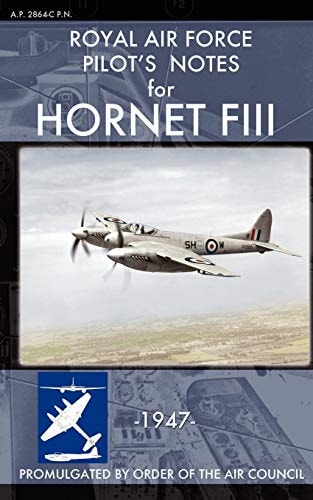
Royal Air Force Pilot's Notes for Hornet F.III
0
0
As an Amazon Associate and affiliate partner, Menrva Books earns from qualifying purchases. Learn more
Author Description
Designed during WWII as a long-range fighter, the Hornet represented an evolution of the de Havilland Mosquito and was the fastest piston-powered fighter in Royal Air Force service. Like the Mosquito, the Hornet had a fuselage built largely of balsa and plywood, but boasted laminar flow wings and massive Rolls-Royce V12 engines with 12-foot diameter, four-bladed props. It could achieve a speed of 472 mph at 22,000 feet, had a range of 3,000 miles, and was intended to operate from bases on land and aircraft carriers. It was normally equipped to carry two 1,000 lb. bombs, eight rockets, and fitted with four 20mm nose-mounted cannon. Although it first flew in 1944, the Hornet did not achieve operational status until WWII was over. The plane's real worth was revealed during the Malayan Emergency, when Hornet squadrons flew in the ground attack role against Communist insurgents. During five years in combat, Hornets achieved 4,500 operational sorties. The aircraft was withdrawn from RAF service by mid-1956. The Sea Hornet version served with the fleet from 1947 to 1954, and planes continued to fly with secondary units until 1957. These pilot's notes were standard issue for R.A.F. pilots circa 1947. They contain information about aircraft operation, controls, handling, and emergencies. This reproduction features all of the original text and photos in black and white, and full color covers.
Menrva's Summary
THE THESIS
The de Havilland Hornet F.3 was a high-performance piston-powered aircraft developed during WWII, intended for long-range fighter and carrier operations. This aircraft, an evolution of the de Havilland Mosquito, featured a balsa and plywood fuselage, laminar flow wings, and powerful Rolls-Royce V12 engines. It was capable of high speeds and extensive range, designed to carry a significant armament including bombs, rockets, and cannons. Though its operational debut occurred after WWII, the Hornet proved its worth in ground attack missions during the Malayan Emergency, amassing thousands of operational sorties.
THE SCOPE MAP
- Detailed information on aircraft operation and controls.
- Guidance on handling characteristics in various flight regimes.
- Procedures for emergency situations.
- Technical specifications and performance data.
- Historical context of the Hornet's development and service.
- Information on both land-based and carrier operations.
- Details on armament and payload capabilities.
THE AUTHORITY PERSPECTIVE
These pilot's notes provide a direct look into the operational knowledge required for the de Havilland Hornet F.3, a significant aircraft in post-WWII aviation. The reproduction aims to preserve the original content, including text and photographs, offering a valuable resource for aviation enthusiasts and historians. The historical context provided highlights the aircraft's service, particularly its role in the Malayan Emergency, underscoring its combat effectiveness. This document serves as a primary source for understanding the practical application and handling of this advanced piston-engined fighter.
Page Count:
60
Publication Date:
2012-05-01
Publisher:
Periscope Film, LLC
ISBN-10:
1937684830
ISBN-13:
9781937684839
History
Non-Fiction
Reference
Aviation
Military History
Community Tags
Similar Books