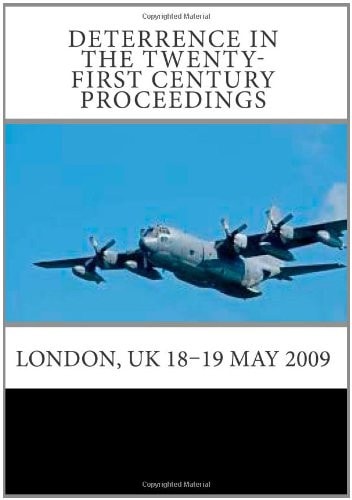
Deterrence in the Twenty-First Century: Proceedings, London, UK, 18-19 May 2009
0
0
As an Amazon Associate and affiliate partner, Menrva Books earns from qualifying purchases. Learn more
Author Description
Deterrence has long been a cornerstone of interaction among states. This was especially true when state interests clashed and when political leaders sought to avoid direct military conflict. In traditional deterrence relationships, calculations of military, economic, and diplomatic power determined the degrees of deterrence effectiveness. This seemed to change with the advent of the Cold War. The potential destructiveness of nuclear weapons combined with the relatively small numbers of states that possessed them suggested a need for new concepts of deterrence tailored to govern the nuclear competition among the Soviet Union, the United States, and their allies. Deterrence thinking came to mean nuclear deterrence-and as the Cold War wound down, there was a general perception that the absence of nuclear confrontation among the great powers required less emphasis on deterrence as a key feature of national strategy and a corresponding decrease in the instruments of deterrence that had prevailed during the Cold War. As the collapse of the superpower confrontation became more distant, however, states began to confront threats that were present during the Cold War but were perceived to be less important- what some have termed lesser included threats. These threats involved state failure, mass migration of populations, and drug, small arms, and human trafficking. Also included were environmental and humanitarian disasters, traditional state competition, proliferation of weapons of mass destruction and their components, and the emergence of nonstate actors empowered by new communication and information technologies that give them global reach. Taken individually, few of these threats have the potential to overthrow established and functioning states-especially in the developed world. However, these threats present challenges that policy makers struggle to meet using traditional diplomacy. Economic sanctions and incentives have exerted little apparent effect toward solving so
Menrva's Summary
THE THESIS
The nature and application of deterrence strategies are re-examined in the context of evolving global threats. This book presents the proceedings from a conference held in London in May 2009, focusing on the historical evolution and contemporary relevance of deterrence. It contrasts traditional power-based calculations with the complexities introduced by nuclear weapons during the Cold War and the subsequent shift in focus as superpower confrontation waned. The text explores how policymakers grapple with a new landscape of threats, including state failure, mass migration, trafficking, environmental disasters, WMD proliferation, and the rise of non-state actors, which challenge conventional diplomatic and economic tools.
THE SCOPE MAP
- Historical overview of deterrence theory and practice.
- Analysis of nuclear deterrence during the Cold War.
- Examination of emerging threats in the post-Cold War era.
- Discussion of state failure, migration, and trafficking as security challenges.
- The impact of non-state actors and new technologies on deterrence.
- Challenges to traditional diplomacy and economic sanctions.
- Policy implications for 21st-century security strategy.
THE AUTHORITY PERSPECTIVE
The proceedings from the 2009 conference offer a comprehensive look at the enduring and evolving concept of deterrence. The collection likely provides a detailed analysis of historical deterrence strategies, from traditional power dynamics to the unique challenges posed by nuclear weapons during the Cold War. It is expected to explore the shift in focus towards 'lesser included threats' and the difficulties policymakers face in addressing these contemporary issues with established methods. The discussions aim to inform strategies for navigating a complex global security environment.
Page Count:
326
Publication Date:
2010-09-01
Publisher:
CreateSpace Independent Publishing Platform
ISBN-10:
1466433221
ISBN-13:
9781466433229
Politics
History
Non-Fiction
Security Studies
International relations
Community Tags
Similar Books







Reader Comments
Share Your Thoughts
No comments yet. Be the first to share your thoughts!