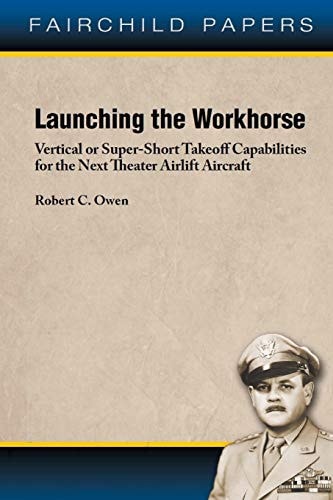
Launching the Workhorse: Vertical Or Super-Short Takeoff Capabilities for the Next Theater Airlift Aircraft
0
0
As an Amazon Associate and affiliate partner, Menrva Books earns from qualifying purchases. Learn more
Author Description
This study is an assessment of whether the US Air Force (USAF) should anticipate modernizing its core theater airlift fleet with aircraft designed for super-short takeoffs or landings under rough-field conditions (SSTOL-RF) or aircraft designs focused on vertical takeoffs or landings (VTOL) with secondary SSTOL-RF capabilities (V/SSTOL-RF). Several considerations speak to the timeliness of this issue. Most importantly, the ongoing evolution of USAF and Army (USA) war-fighting concepts increase their demand for mobility and sustainment support in quantities and places that the aircraft in the present airlift fleet cannot provide. Also, the present mainstay of the theater airlift fleet, the C-130, has been an inadequate platform for vital missions for decades. It is too small to link effectively and efficiently with large intertheater airlifters, such as the C-5, C-17, and civil reserve air fleet (CRAF) jumbo cargo aircraft at intermediate staging bases. Also, the C-130's runway requirements limit its ability to connect to battlefield airlift helicopters or deliver forces and sustainment at forward-most points of need and effect (PON/E) themselves. Intratheater airlift, consequently, is the weak link in the USAF's ability to provide a smooth flow of air and land combat forces and their sustainment in the early stages of conflicts and crises. Finally, although the USAF has not published a formal plan for theater airlift modernization, most officials interviewed for this study suggested sometime in the 2040s as the window for the next aircraft to appear. Given the experience of the C-17 program, which took 19 years to move from development contract to the first squadron reaching initial operational capability, a program aimed at putting a squadron of future theater airlifters on line by the middle 2040s should begin sometime in the early 2020s. As a contribution to conceptualizing the best path to a modern theater airlift fleet, then, this study will assess the SSTOL-RF
Menrva's Summary
THE THESIS
This study assesses whether the U.S. Air Force should modernize its theater airlift fleet with aircraft designed for super-short takeoff and landing under rough-field conditions (SSTOL-RF) or vertical takeoff and landing (VTOL) with secondary SSTOL-RF capabilities (V/SSTOL-RF). The ongoing evolution of U.S. Air Force and Army war-fighting concepts demands increased mobility and sustainment support beyond the capabilities of the current airlift fleet. The existing C-130 platform is inadequate for vital missions due to its size limitations in linking with larger airlifters and its runway requirements, which restrict its ability to connect with battlefield helicopters or deliver forces to forward-most points of need. This study, therefore, examines the strategic and operational implications of different aircraft designs to address the identified weaknesses in intratheater airlift and ensure a smooth flow of air and land combat forces and their sustainment in early conflict stages.
THE SCOPE MAP
- Analysis of the need for modernizing the USAF theater airlift fleet.
- Assessment of Super-Short Takeoff and Rough-Field (SSTOL-RF) aircraft capabilities.
- Evaluation of Vertical Takeoff and Landing (VTOL) with secondary SSTOL-RF capabilities (V/SSTOL-RF).
- Discussion of the limitations of the current C-130 fleet.
- Examination of the C-130's inability to effectively link with larger intertheater airlifters.
- Analysis of C-130 runway requirements and their impact on forward deployment.
- Consideration of the timeline for next-generation theater airlift aircraft, targeting the mid-2040s.
- Exploration of the conceptualization for the best path to a modern theater airlift fleet.
THE AUTHORITY PERSPECTIVE
This study is an analytical assessment of future airlift capabilities for the U.S. Air Force, focusing on the strategic necessity for modernization. It meticulously details the operational shortcomings of the current C-130 fleet and explores the potential benefits and challenges of adopting SSTOL-RF or V/SSTOL-RF aircraft. The work is grounded in the evolving demands of joint war-fighting concepts and the practical limitations of existing aircraft, suggesting a critical need for a new generation of theater airlifters.
Page Count:
36
Publication Date:
2019-06-28
Publisher:
Independently Published
ISBN-10:
1076805973
ISBN-13:
9781076805973
Science & Technology
Non-Fiction
History
Aviation
Military History
Defense Policy
Logistics
Community Tags
Similar Books


Reader Comments
Share Your Thoughts
No comments yet. Be the first to share your thoughts!