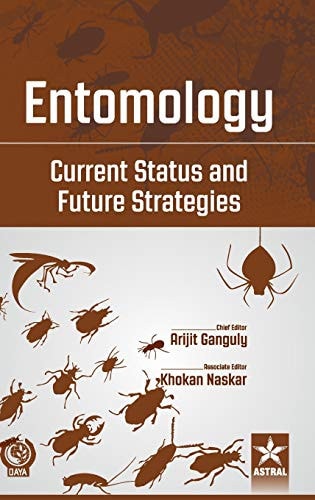
Entomology Current Status and Future Strategies
0
0
As an Amazon Associate and affiliate partner, Menrva Books earns from qualifying purchases. Learn more
Author Description
The book is divided into seven segments: Insect diversity and conservation, environmental toxicology of insects, insect taxonomy, insect behaviour, medicinal value of insects, Insects as food for human and livestock, and insect pest management. In the first segment there is a general discussion on the biodiversity and conservation of insects with emphasis on India, next will be a chapter on grasshopper diversity, followed by how acridid grasshoppers play an important role in conserving forest ecosystem health. In the second segment it will be discovered how heavy metal pollution is impacting grasshopper population. The third segment will dealing with a wide taxonomical review on the order Diptera that have medical importance. In the fourth segment the foraging behaviour of two ant species has been revealed. In the fifth segment you will gain knowledge about nutraceuticals and medicinal insects that is yet a very less explored field. In the sixth segment we have tried to put some lights on the edible insects of Latin American countries, which will followed by a discussion on a very special group of Mexican edible hemipteran: The Jumiles. The last chapter of this segment will disclose nutrients and anti-nutrients of a potential food insect from India. In the concluding seventh segment ideas of pest control using semiochemicals will be revealed that are most recent eco-friendly way for pest management. This segment will be concluded with a discussion on the management of a very special and devastating group: The Locusts. We are very sure that readers will enjoy this book and the information provided in this book will be utilized by the researchers working on insect science across the globe.
Menrva's Summary
THE THESIS
This book investigates the current state of entomology, exploring insect diversity, conservation, toxicology, taxonomy, behavior, medicinal and nutritional value, and pest management strategies. The work is structured into seven segments, beginning with a broad overview of insect biodiversity and conservation, with a specific focus on India, and then delving into topics such as grasshopper diversity and their role in forest ecosystems. Subsequent sections examine the impact of heavy metal pollution on grasshoppers, a taxonomic review of medically important Diptera, and the foraging behavior of ant species. The book also explores the less-charted territories of nutraceuticals and medicinal insects, discusses edible insects from Latin America and Mexico, and analyzes the nutritional content of potential food insects from India. Finally, it concludes with recent eco-friendly pest control methods using semiochemicals and strategies for managing locusts.
THE SCOPE MAP
- Insect diversity and conservation, with an emphasis on India
- Environmental toxicology of insects, focusing on heavy metal pollution's impact on grasshoppers
- A comprehensive taxonomic review of the order Diptera with medical importance
- Analysis of foraging behavior in two ant species
- Exploration of nutraceuticals and medicinal insects
- Discussion on edible insects from Latin American countries, including a focus on Mexican Jumiles
- Nutritional and anti-nutritional analysis of a potential food insect from India
- Recent advancements in pest control using eco-friendly semiochemicals and management strategies for locusts
THE AUTHORITY PERSPECTIVE
The book is presented as a comprehensive resource for researchers in insect science, aiming to provide valuable information across a wide spectrum of entomological topics. The structure suggests a detailed exploration of both fundamental and applied aspects of entomology, from biodiversity and taxonomy to practical applications in medicine, food, and pest control. The inclusion of regional case studies from India, Latin America, and Mexico indicates a global perspective on insect-related issues. The authors express confidence that the content will be well-received and utilized by the scientific community.
Page Count:
302
Publication Date:
2018-01-01
Publisher:
Daya Publishing House
ISBN-10:
9387057593
ISBN-13:
9789387057593
Non-Fiction
Science
Conservation
Entomology
Mexico
India
Latin America
Community Tags
Similar Books