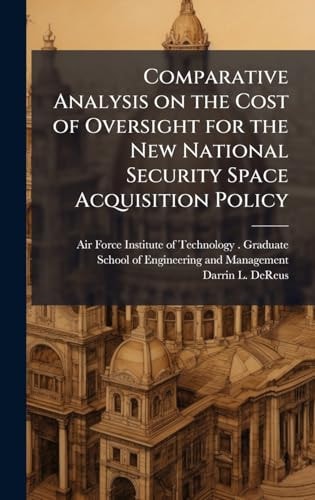
Comparative Analysis on the Cost of Oversight for the New National Security Space Acquisition Policy
0
0
As an Amazon Associate and affiliate partner, Menrva Books earns from qualifying purchases. Learn more
Author Description
For the past 50 years, the military's use of space for our national defense has increased exponentially. The use of space has increased so much that recent events have led to the approval for most space Major Defense Acquisition Programs to fall under their own process of oversight to track and monitor these programs. The largest reason for this change is due to the difference in spending profiles and current acquisition regulations that are not structured to meet these space expenditure plans. The key problem is no one knows, for sure, how much the oversight process actually costs and if one form of oversight is actually statistically better than the other. If the other processes are better, what actually drives the cost for their oversight? This thesis will provide a foundation and potential cost saving recommendations that would benefit the Department of Defense in most of the acquisition programs it monitors. The cost of oversight will be forecasted based on a panel of experts in the field, using the Delphi Methodology. These costs will then compare with other oversight processes for the Department of Defense Directive 5000 and the Command, Control, Communication, and Intelligence new virtual process, to discover where the statistical differences are in the cost of oversight. The total costs for all three oversight processes will then provide insight on where the largest cost benefits appear to be, based on data collected, and recommendations will develop a future track for the next generation of oversight processes. This work has been selected by scholars as being culturally important, and is part of the knowledge base of civilization as we know it. This work was reproduced from the original artifact, and remains as true to the original work as possible. Therefore, you will see the original copyright references, library stamps (as most of these works have been housed in our most important libraries around the world), and other notations in the work.</p
Menrva's Summary
THE THESIS
This thesis investigates the unknown costs associated with new oversight policies for national security space acquisition programs. The author addresses the exponential increase in military space utilization over the past 50 years, which has necessitated new oversight processes due to differing spending profiles and acquisition regulations. The core problem is the lack of clear data on the actual cost of these oversight processes and whether one method is statistically superior to another. This work aims to provide a foundational analysis and potential cost-saving recommendations for the Department of Defense by forecasting oversight costs using expert panels and the Delphi Methodology, comparing them against existing DoD Directive 5000 and C3I virtual processes.
THE SCOPE MAP
- Analysis of the historical increase in military space utilization and its impact on acquisition policy.
- Identification of the key problem: the unknown cost and comparative effectiveness of different oversight processes.
- Forecasting of oversight costs using a panel of experts and the Delphi Methodology.
- Comparison of new space acquisition oversight costs with established processes like DoD Directive 5000 and C3I virtual processes.
- Identification of statistical differences in the cost of oversight across various methods.
- Derivation of insights into the largest cost benefits based on collected data.
- Development of recommendations for future generations of oversight processes.
THE AUTHORITY PERSPECTIVE
This work is presented as a culturally important artifact, reproduced from original sources and preserved in major libraries. Its methodology relies on expert forecasting via the Delphi technique to estimate costs, which are then compared against existing defense acquisition oversight models. The research aims to provide data-driven recommendations for cost savings within the Department of Defense's acquisition programs, focusing on the evolving landscape of national security space initiatives.
Page Count:
114
Publication Date:
2025-05-22
Publisher:
Creative Media Partners, LLC
ISBN-10:
1025077431
ISBN-13:
9781025077437
Politics
Economics
Non-Fiction
Aerospace
Public Policy
National security
Community Tags
Similar Books






Reader Comments
Share Your Thoughts
No comments yet. Be the first to share your thoughts!