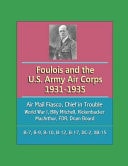
Foulois and the U.S. Army Air Corps 1931-1935: Air Mail Fiasco, Chief in Trouble, World War I, Billy Mitchell, Rickenbacker, MacArthur, FDR, Drum Board, B-7, B-9, B-10, B-12, B-17, DC-2, XB-15
0
0
As an Amazon Associate and affiliate partner, Menrva Books earns from qualifying purchases. Learn more
Author Description
In this thoroughly researched and lucidly written volume, Lt. Col. John F. Shiner describes the Air Corps' effort to prepare the nation for war; to gain money, aircraft, and, even more important, independence; and to achieve a capability to wage aerial war. The focus of the work is Maj. Gen. Benjamin Foulois and his tenure as Chief of the Air Corps between 1931 and 1935. But the implications of Shiner's findings go beyond either the personalities or the issues. They encompass the whole character of developing United States military policy and its ascendancy to leadership in aviation during World War II. At the beginning of Foulois' stewardship, the Air Corps lacked both a "specific mission" and a "clearly defined doctrine." It possessed neither the aircraft not the organization for an independent role in conflict. War Department leaders were convinced that future war would be decided in ground fighting and that the most logical and effective mission for air power was in support of the land forces. On its part, the Navy was determined to develop its own air arm and to prevent army aviation from gaining any mission that overlapped into the naval environment. From these battles merged the foundations of the large air fleets that helped to bring victory in World War II. Shiner shows that Army leaders were neither as backward nor as resistant to aviation as had been previously thought. Out of Foulois' term as Chief of the Air Corps came a fully articulated doctrine of long-range bombardment, its acceptance as part of official Army doctrine, the beginning of the program for the procurement of the B-17, and the missions for Army aviation of air and coastal defense. Even more important, pressed by Foulois' badgering, the Army established GHQ Air Force, a major step toward autonomy which allowed the Air Corps to unify its strike forces, to concentrate them under a single air commander, and to train and develop the striking forces which could command the air and attack and en
Menrva's Summary
THE THESIS
This volume investigates the critical period of 1931-1935 within the U.S. Army Air Corps, focusing on Major General Benjamin Foulois's tenure as Chief of the Air Corps. The book details the Air Corps' struggle to prepare for future conflict by securing funding, advanced aircraft, and operational independence, all while navigating inter-service rivalries and prevailing military doctrines that favored ground forces. It examines how Foulois's persistent efforts and the evolving geopolitical landscape laid the groundwork for the U.S. to achieve air superiority in World War II.
THE SCOPE MAP
- The tenure of Maj. Gen. Benjamin Foulois as Chief of the Air Corps (1931-1935).
- The Air Corps' efforts to gain financial resources, acquire new aircraft, and achieve operational autonomy.
- The prevailing military doctrine that prioritized ground combat and viewed air power primarily as a support role.
- The U.S. Navy's development of its own air arm and its efforts to prevent Army aviation from encroaching on naval missions.
- The emergence of a fully articulated doctrine of long-range bombardment.
- The acceptance of this doctrine into official Army policy.
- The initiation of the procurement program for the B-17 aircraft.
- The establishment of the GHQ Air Force, a significant step towards autonomy for the Air Corps.
THE AUTHORITY PERSPECTIVE
This work is presented as a thoroughly researched and lucidly written volume, focusing on a pivotal period in the development of U.S. military aviation policy. The author's findings suggest that Army leaders were not as resistant to aviation advancements as previously believed, highlighting the complex inter-service dynamics and doctrinal debates of the era. The book's implications extend beyond the specific personalities involved, offering insights into the broader trajectory of American military policy and its eventual leadership in aviation during World War II.
Page Count:
292
Publication Date:
2017-06-02
Publisher:
Amazon Digital Services LLC - KDP Print US
ISBN-10:
1521424128
ISBN-13:
9781521424124
History
Non-Fiction
Aviation History
Military History
Air Force
Community Tags
Similar Books






Reader Comments
Share Your Thoughts
No comments yet. Be the first to share your thoughts!