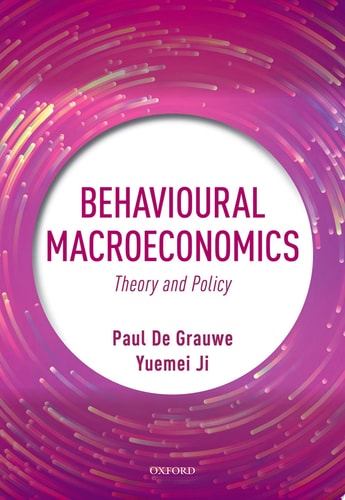
Behavioural Macroeconomics
0
0
As an Amazon Associate and affiliate partner, Menrva Books earns from qualifying purchases. Learn more
Author Description
Modern Macroeconomics Has Been Based On The Paradigm Of The Rational Individual Capable Of Understanding The Complexity Of The World. This Has Created A Very Shallow Theory Of The Business Cycle In Which Nothing Happens In The Macroeconomy Unless Shocks Occur From Outside. Behavioural Macroeconomics: Theory And Policy Uses A Different Paradigm. It Assumes That Individual Agents Experience Cognitive Limitations Preventing Them From Having Rational Expectations. Instead These Individuals Use Simple Rules Of Behaviour. Behavioural Macroeconomics Introduces Rationality By Allowing Individuals To Learn From Their Mistakes And To Switch To The Rules That Perform Better. It Introduces The Idea Of Endogenously Generated Animals Spirits That Drive The Business Cycle And Are In Turn Influenced By It, And Applies This Model To Shed New Light On A Number Of Important Issues. It Analyses The Role Of Fiscal Policy In Stabilizing The Economy While Maintaining Debt Sustainability; Expands The Model To Include A Banking Sector And Show How Banks Amplify The Booms And Busts; And Explains How Animal Spirits Help To Synchronize The Business Cycles Across Countries. The Model Set Out In Behavioural Macroeconomics Leads To Very Different Policy Implications From The Mainstream Macroeconomic Model. It Shows How Policymakers Have A Responsibility To Stabilize An Otherwise Unstable System.
Menrva's Summary
THE THESIS
This book investigates whether macroeconomic models based on bounded rationality and animal spirits provide a more accurate representation of business cycles than traditional rational expectations models. Paul De Grauwe and Yuemei Ji, both established scholars in international economics and monetary policy, challenge the mainstream paradigm of the perfectly rational agent. They propose a framework where agents utilize simple heuristics and learn from errors, arguing that this approach better captures the endogenous nature of economic instability and the necessity of active policy intervention.
THE SCOPE MAP
What You Will Find
- A formal model of bounded rationality and heuristic-based decision making
- Analysis of endogenous animal spirits and their role in business cycle fluctuations
- Integration of a banking sector to demonstrate the amplification of economic booms and busts
- Examination of fiscal policy effectiveness and debt sustainability under non-rational conditions
Scope Limits
- The text does not provide a comprehensive history of macroeconomic thought
- It does not cover micro-level psychological experiments beyond their application to aggregate economic modeling
THE AUTHORITY PERSPECTIVE
Experts recognize this work as a significant contribution to the field of heterodox macroeconomics, offering a rigorous alternative to standard dynamic stochastic general equilibrium models. Readers frequently note the technical density of the prose, which requires a solid foundation in mathematical economics to fully grasp the model's implications.
Page Count:
256
Publication Date:
2019-01-01
Publisher:
Oxford University Press
ISBN-10:
0192568353
ISBN-13:
9780192568359
Economics
Business
Economic Theory
Macroeconomics
Finance
Community Tags
Similar Books