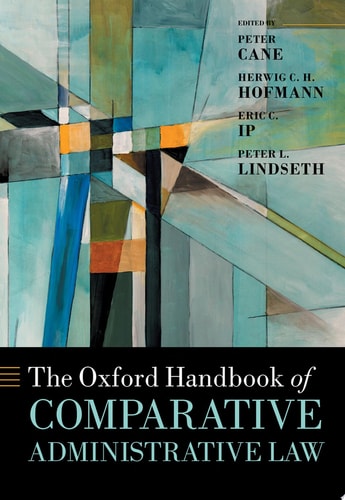
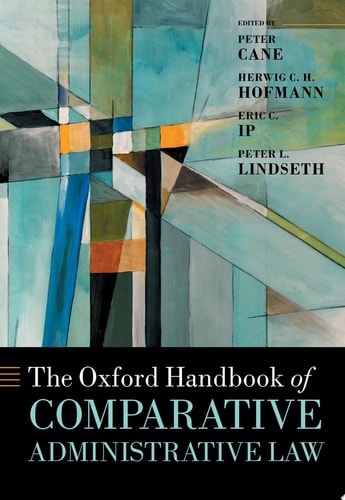
The Oxford Handbook of Comparative Administrative Law
0
0
As an Amazon Associate and affiliate partner, Menrva Books earns from qualifying purchases. Learn more
Author Description
The comparative study of administrative law has a long history dating back more than 200 years. It has enjoyed a renaissance in the past 15 years or so and now sits alongside fields such as comparative constitutional law and global administrative law as a well-established area of scholarly research. This book is the first to provide a broad and systematic view of the subject both in terms of the topics covered and the legal traditions surveyed. In its various parts it surveys the historical beginnings of comparative administrative law scholarship, discusses important methodological issues, examines the relationship between administrative law and regime type, analyses basic concepts such as 'administrative power' and 'accountability', and deals with the creation, functions, and control of administrative power, and values of administration. The final part looks to the future of this young sub-discipline. In this volume, distinguished experts and leaders in the field discuss a wide range of issues in administrative law from a comparative perspective. Administrative law is concerned with the conferral, nature, exercise, and legal control of administrative (or 'executive') governmental power. It has close links with other areas of 'public law', notably constitutional law and international law. It is of great interest and importance not only to lawyers but also to students of politics, government, and public policy. Studying public law comparatively helps to identify both similarities and differences between the way government power and its control is managed in different countries and legal traditions.
Menrva's Summary
THE THESIS
This volume investigates the historical development, methodological frameworks, and contemporary challenges of comparative administrative law as a distinct field of scholarly research. The editors, Eric C. Ip, Herwig C. H. Hofmann, Peter Cane, and Peter L. Lindseth, curate contributions from distinguished experts to synthesize how different legal traditions manage the conferral, exercise, and control of executive governmental power. The text establishes a systematic foundation for understanding administrative law by bridging the gap between constitutional theory and practical governance across global jurisdictions.
THE SCOPE MAP
What You Will Find
- Historical analysis of comparative administrative law scholarship spanning over 200 years.
- Methodological frameworks for conducting comparative legal research.
- Comparative examinations of administrative power, accountability, and regime types.
- Discussions on the creation, functions, and control of executive authority.
Scope Limits
- The text does not provide a comprehensive survey of every individual nation's administrative code.
- It does not serve as a practitioner's manual for specific domestic litigation strategies.
THE AUTHORITY PERSPECTIVE
Experts identify this volume as a foundational reference for scholars and students of public law, politics, and government. Readers frequently note the academic density of the prose, which is tailored for advanced research and comparative legal study.
Page Count:
1000
Publication Date:
2020-01-01
Publisher:
Oxford University Press
ISBN-10:
0192560107
ISBN-13:
9780192560100
Government
Administrative Law
Law
Comparative Law
Public Law
Community Tags
Other Editions(2)
Similar Books




Reader Comments
Share Your Thoughts
No comments yet. Be the first to share your thoughts!