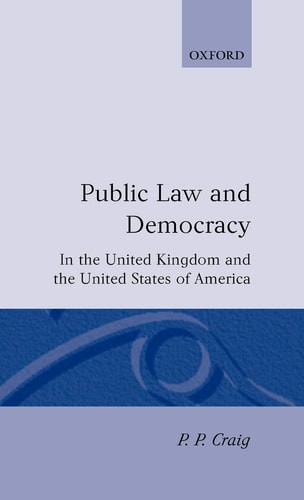
Public Law and Democracy in the United Kingdom and the United States of America
0
0
As an Amazon Associate and affiliate partner, Menrva Books earns from qualifying purchases. Learn more
Author Description
This study brings the fruits of writings in political science and political theory to bear on the issues of public law. A critical examination of the centralist democratic views of Dicey is followed by an extensive discussion of a variety of pluralist theories of democracy, tracing their development in the U.S. from the early twentieth century to their more sophisticated recent versions. A similar analysis is applied to a cross-section of English pluralists, and in all cases the discussion is followed by criticism of the views expounded and an exploration of their implications for public law. This book will be of interest to students and scholars of public law, political science and political theory.
Menrva's Summary
THE THESIS
This study investigates the intersection of political theory and public law by evaluating how different democratic models influence legal frameworks in the United Kingdom and the United States. P. P. Craig, a distinguished scholar in administrative and public law, synthesizes historical political thought with contemporary legal practice. He argues that the structure of public law is inextricably linked to the underlying democratic theories—specifically centralist versus pluralist models—that govern the state. By examining these theories, the author provides a framework for understanding the normative foundations of legal authority in both jurisdictions.
THE SCOPE MAP
What You Will Find
- A comparative analysis of centralist democratic views, specifically focusing on the work of A.V. Dicey.
- An extensive survey of pluralist theories of democracy as they evolved in the United States throughout the twentieth century.
- A critical examination of English pluralist thought and its application to public law institutions.
- A systematic critique of how these competing democratic theories inform and constrain modern public law practice.
THE AUTHORITY PERSPECTIVE
Legal scholars and political theorists frequently cite this text as a foundational work for understanding the theoretical underpinnings of constitutional and administrative law. Experts highlight the book's rigorous academic density and its success in bridging the gap between abstract political philosophy and practical legal application.
Page Count:
456
Publication Date:
1991-03-14
Publisher:
Clarendon Press
ISBN-10:
019825637X
ISBN-13:
9780198256373
Law
Comparative Law
United States
Constitutional Law
Administrative Law
Public Law
Political Theory