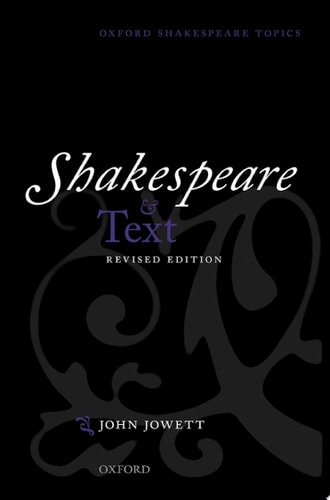
Shakespeare and Text: Revised Edition
0
0
As an Amazon Associate and affiliate partner, Menrva Books earns from qualifying purchases. Learn more
Author Description
Shakespeare and Text is built on the research and experience of a leading expert on Shakespeare editing and textual studies. The first edition has proved its value as an indispensable and unique guide to its topic. It takes Shakespeare readers to the very foundation of his work, explaining how his plays first took shape in the theatre where writing was part of a larger collective enterprise. The account examines the early modern printing industry that produced the earliest surviving texts of Shakespeare's plays. It describes the roles of publisher and printer, the controls exerted through the Stationers' Company, and the technology of printing. A chapter is devoted to the book that gathered Shakespeare's plays together for the first time, the First Folio of 1623. Shakespeare and Text goes on to survey the major developments in textual studies over the past century. It builds on the recent upsurge of interest in textual theory, and deals with issues such as collaboration, the instability of the text, the relationship between theatre culture and print culture, and the book as a material object. Later chapters examine the current critical edition, explaining the procedures that transform early texts in to a very different cultural artefact, the edition in which we regularly encounter Shakespeare. The new revised edition, which builds on Jowett's research for the New Oxford Shakespeare, engages with scholarship of the past decade, work that has transformed our understanding of textual versions, has opened up the taxonomy of Shakespeare's texts, and has significantly extended the picture of Shakespeare as a co-author. A new chapter describes digital text, digital editing, and their interface with the traditional media.
Menrva's Summary
THE THESIS
How do the material conditions of early modern printing and the collaborative nature of Elizabethan theatre shape the texts of Shakespeare’s plays that we read today? John Jowett, a prominent scholar in Shakespearean editing, utilizes his extensive research from the New Oxford Shakespeare project to analyze the evolution of these texts. He argues that Shakespeare’s works are not static artifacts but products of complex interactions between theatre culture, printing technology, and editorial intervention. The book provides a framework for understanding how these historical processes influence modern critical editions.
THE SCOPE MAP
What You Will Find
- Analysis of the early modern printing industry and the Stationers' Company.
- Detailed examination of the 1623 First Folio.
- Overview of 20th and 21st-century developments in textual theory.
- Discussion of digital editing and its impact on traditional media.
Scope Limits
- The text focuses primarily on the textual history and editorial processes rather than literary interpretation or thematic analysis of the plays themselves.
THE AUTHORITY PERSPECTIVE
Scholars and students frequently identify this work as a foundational text for understanding the complexities of Shakespearean textual studies. Experts highlight the book's clarity in navigating dense editorial theory and its relevance to both traditional print and modern digital scholarship.
Page Count:
259
Publication Date:
2019-01-01
Publisher:
OUP Oxford
ISBN-10:
0192562614
ISBN-13:
9780192562616
English
Academic
Printing History
English & College Success
Reference
Literary Criticism
Community Tags
Similar Books