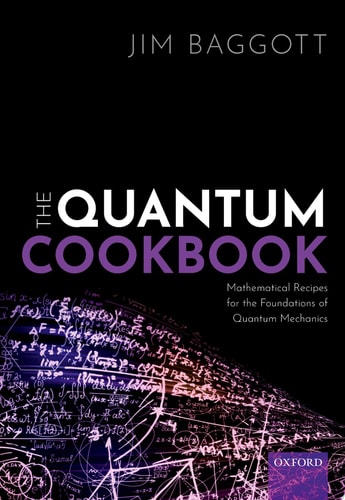
The Quantum Cookbook: Mathematical Recipes for the Foundations of Quantum Mechanics
0
0
As an Amazon Associate and affiliate partner, Menrva Books earns from qualifying purchases. Learn more
Author Description
Quantum mechanics is an extraordinarily successful scientific theory. But it is also completely mad. Although the theory quite obviously works, it leaves us chasing ghosts and phantoms; particles that are waves and waves that are particles; cats that are at once both alive and dead; lots of seemingly spooky goings-on; and a desperate desire to lie down quietly in a darkened room. The Quantum Cookbook explains why this is. It provides a unique bridge between popular exposition and formal textbook presentation, written for curious readers with some background in physics and sufficient mathematical capability. It aims not to teach readers how to do quantum mechanics but rather helps them to understand how to think about quantum mechanics. Each derivation is presented as a 'recipe' with listed ingredients, including standard results from the mathematician's toolkit, set out in a series of easy-to-follow steps. The recipes have been written sympathetically, for readers who - like the author - will often struggle to follow the logic of a derivation which misses out steps that are 'obvious', or which use techniques that readers are assumed to know.
Menrva's Summary
THE THESIS
This book investigates the conceptual foundations of quantum mechanics by bridging the gap between popular science exposition and formal academic textbooks. Author Jim Baggott, a science writer with a background in physical chemistry, utilizes a structured, step-by-step pedagogical framework to demystify the mathematical derivations that underpin quantum theory. The text is designed to assist readers who possess foundational physics knowledge but require clarity on the logical progression of complex quantum mechanical proofs.
THE SCOPE MAP
What You Will Find
- A collection of mathematical derivations presented as 'recipes' with explicit ingredients and procedural steps.
- Explanations of core quantum phenomena including wave-particle duality and superposition.
- A focus on the logical 'missing links' often omitted in standard academic literature.
Scope Limits
- The book does not aim to teach the reader how to perform professional-level quantum mechanical calculations.
- It does not provide an exhaustive historical account of the development of quantum theory.
THE AUTHORITY PERSPECTIVE
Readers frequently note that the book serves as an effective bridge for those transitioning from popular science to more rigorous study. Experts highlight the text as a useful supplementary resource for students who find standard textbook derivations overly opaque or poorly explained.
Page Count:
314
Publication Date:
2020-01-01
Publisher:
OUP Oxford
ISBN-10:
0192562894
ISBN-13:
9780192562890
Science
Physics
Mathematics
Education
Earth Sciences
Community Tags
Similar Books