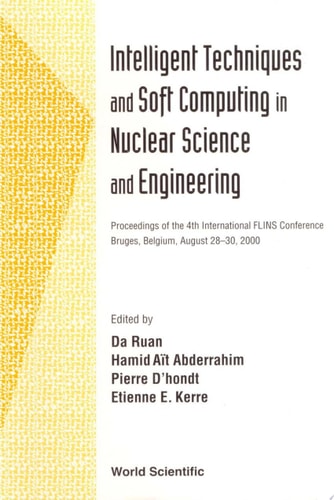
Intelligent Techniques and Soft Computing in Nuclear Science and Engineering: Proceedings of the 4th International FLINS Conference
0
0
As an Amazon Associate and affiliate partner, Menrva Books earns from qualifying purchases. Learn more
Author Description
This book is divided into three parts. The first part, “Mathematical Tools and New Developments”, provides basic tools to treat fuzzy set theory, rough set theory, fuzzy control, fuzzy modelling, decision support systems, and related applications. The second part, “Intelligent Engineering Applications”, reports on engineering problems such as man-machine interface, risk analysis, image processing, robotics, knowledge-based engineering, expert systems, process control integration, diagnosis, measurements and interpretation by intelligent techniques and soft computing used for general engineering applications. The third part, “Nuclear Engineering Applications”, concentrates on nuclear applications and covers several topics such as nuclear energy, nuclear safety assessment, radioactive waste management, nuclear measurements, nuclear safeguards, nuclear reactor operation, reactor controller design, fuel reload pattern design, signal validation, nuclear power plants, and optimizations in nuclear applications.
Menrva's Summary
THE THESIS
This collection explores the intersection of advanced computational techniques and the complex challenges within nuclear science and engineering. The proceedings are structured into three distinct parts, beginning with foundational mathematical tools for fuzzy set theory, rough sets, and decision support systems. It then moves to broad engineering applications, including risk analysis, robotics, and process control, before focusing specifically on nuclear applications such as safety assessment, waste management, reactor operation, and fuel management.
THE SCOPE MAP
- Mathematical Tools and New Developments: Fuzzy set theory, rough set theory, fuzzy control, fuzzy modeling, decision support systems.
- Intelligent Engineering Applications: Man-machine interface, risk analysis, image processing, robotics, knowledge-based engineering, expert systems, process control integration, diagnosis, measurements and interpretation.
- Nuclear Engineering Applications: Nuclear energy, nuclear safety assessment, radioactive waste management, nuclear measurements, nuclear safeguards, nuclear reactor operation, reactor controller design, fuel reload pattern design, signal validation, nuclear power plants, and optimizations.
- Focus on the application of intelligent techniques and soft computing to solve real-world engineering problems.
- Coverage of both theoretical frameworks and practical implementations in various engineering domains.
THE AUTHORITY PERSPECTIVE
The proceedings of the 4th International FLINS Conference present a comprehensive overview of the application of intelligent techniques and soft computing across diverse scientific and engineering fields. The structure of the book, moving from foundational mathematical concepts to broad engineering applications and finally to specialized nuclear engineering challenges, suggests a thorough exploration of the subject matter. The inclusion of topics ranging from fuzzy set theory to nuclear reactor operation indicates a broad scope intended for researchers and practitioners in these specialized areas. This collection likely serves as a valuable reference for those seeking to leverage computational intelligence in complex technical domains.
Page Count:
556
Publication Date:
2000-08-04
Publisher:
World Scientific
ISBN-10:
9814492795
ISBN-13:
9789814492799
Science & Technology
Non-Fiction
Science
Nuclear Engineering
Engineering
Community Tags
Similar Books