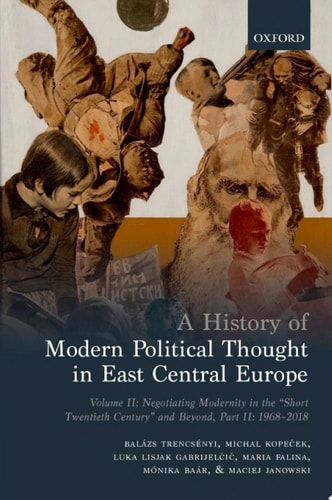
A History of Modern Political Thought in East Central Europe: Volume II: Negotiating Modernity in the 'Short Twentieth Century' and Beyond, Part II: 1968-2018
0
0
As an Amazon Associate and affiliate partner, Menrva Books earns from qualifying purchases. Learn more
Author Description
A History of Modern Political Thought in East Central Europe is a synthetic work, authored by an international team of researchers, covering twenty national cultures and 250 years. It goes beyond the conventional nation-centered narratives and presents a novel vision especially sensitive to the cross-cultural entanglement of political ideas and discourses. Its principal aim is to make these cultures available for the global 'market of ideas' and revisit some of the basic assumptions about the history of modern political thought, and modernity as such. The present volume is the final part of the project, following Volume I: Negotiating Modernity in the 'Long Nineteenth Century', and Volume II, Part I: Negotiating Modernity in the 'Short Twentieth Century' (1918-1968) (OUP, 2018). Its starting point is the defeat of the vision of 'socialism with a human face' in 1968 and the political discourses produced by the various 'consolidation' or 'normalization' regimes. It continues with mapping the exile communities' and domestic dissidents' critical engagement with the local democratic and anti-democratic traditions as well as with global trends. Rather than achieving the coveted 'end of history', however, the liberal democratic order created in East Central Europe after 1989 became increasingly contested from left and right alike. Thus, instead of a comfortable conclusion pointing to the European integration of most of these countries, the book closes with a reflection on the fragility of democracy in this part of the world and beyond.
Menrva's Summary
THE THESIS
This volume investigates how political thought in East Central Europe evolved from the 1968 suppression of reformist socialism through the post-1989 transition and into the contemporary era of democratic contestation. The authors, an international team of researchers, utilize a comparative, cross-cultural framework to analyze how regional intellectuals navigated the tension between local traditions and global political trends. By moving beyond nation-centered narratives, the text argues that the region's political discourse is defined by a persistent, critical engagement with the shifting definitions of modernity and the inherent fragility of democratic institutions.
THE SCOPE MAP
What You Will Find
- Analysis of political discourses during the normalization regimes following 1968.
- Examination of intellectual contributions from both domestic dissidents and exile communities.
- Evaluation of the post-1989 liberal democratic order and its subsequent contestation by various political factions.
- Comparative study of twenty national cultures across East Central Europe.
Scope Limits
- The text focuses primarily on political thought and discourse rather than a comprehensive military or economic history of the region.
- It does not attempt to provide a definitive resolution to the ongoing political debates within the region, focusing instead on the historical trajectory of these ideas.
THE AUTHORITY PERSPECTIVE
Experts recognize this work as a significant contribution to the intellectual history of East Central Europe, noting its ambitious scope and departure from traditional nationalist historiography. Readers frequently highlight the academic density of the prose and the rigorous, multi-authored approach to complex political developments.
Page Count:
400
Publication Date:
2018-01-01
Publisher:
OUP Oxford
ISBN-10:
0192565087
ISBN-13:
9780192565082
History
European History
Political Philosophy
Community Tags
Similar Books
Reader Comments
Share Your Thoughts
No comments yet. Be the first to share your thoughts!