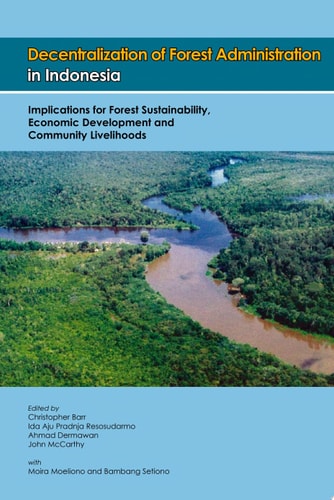
Decentralization of Forest Administration in Indonesia: Implications for Forest Sustainability, Economic Development, and Community Livelihoods
0
0
As an Amazon Associate and affiliate partner, Menrva Books earns from qualifying purchases. Learn more
Author Description
Since the collapse of Soeharto’s New Order regime in May 1998, Indonesia’s national, provincial, and district governments have engaged in an intense struggle over how authority and the power embedded in it, should be shared. How this ongoing struggle over authority in the forestry sector will ultimately play out is of considerable significance due to the important role that Indonesia’s forests play in supporting rural livelihoods, generating economic revenues, and providing environmental services. This book examines the process of forestry sector decentralization that has occurred in post-Soeharto Indonesia, and assesses the implications of more recent efforts by the national government to recentralize administrative authority over forest resources. It aims to describe the dynamics of decentralization in the forestry sector, to document major changes that occurred as district governments assumed a greater role in administering forest resources, and to assess what the ongoing struggle among Indonesia’s national, provincial, and district governments is likely to mean for forest sustainability, economic development at multiple levels, and rural livelihoods. Drawing from primary research conducted by numerous scientists both at CIFOR and its many Indonesian and international partner institutions since 2000, this book sketches the sectoral context for current governmental reforms by tracing forestry development and the changing structure of forest administration from Indonesia’s independence in 1945 to the fall of Soeharto’s New Order regime in 1998. The authors further examine the origins and scope of Indonesia’s decentralization laws in order to describe the legal-regulatory framework within which decentralization has been implemented both at the macro-level and specifically within the forestry sector. This book also analyses the decentralization of Indonesia’s fiscal system and describes the effects of the country’s new fiscal balancing arrangements on revenue flo
Menrva's Summary
THE THESIS
The book investigates the complex and evolving landscape of forest administration decentralization in Indonesia following the collapse of the New Order regime. It examines the ongoing power struggles between national, provincial, and district governments over authority in the forestry sector, assessing the implications for forest sustainability, economic development, and community livelihoods. The authors analyze the dynamics of decentralization, the changes brought about by district governments assuming greater administrative roles, and the potential consequences of recentralization efforts.
THE SCOPE MAP
- Historical context of Indonesian forest administration from independence to 1998.
- Analysis of the decentralization laws and their implementation in the forestry sector.
- Examination of the fiscal system decentralization and its effects on revenue.
- Assessment of the impact of decentralization on forest sustainability.
- Evaluation of the effects on economic development at multiple levels.
- Exploration of the consequences for rural livelihoods.
- Insights into the ongoing struggle for administrative authority over forest resources.
THE AUTHORITY PERSPECTIVE
This book offers a comprehensive analysis of a critical period in Indonesian environmental and governance history. The research, drawing from extensive primary data collected since 2000 by CIFOR and partner institutions, provides a detailed account of the decentralization process. It is likely to be of significant interest to academics, policymakers, and NGOs involved in natural resource management, governance, and development in Indonesia and similar contexts. The work aims to inform current debates on how to best manage forest resources for both ecological and economic benefit.
Page Count:
178
Publication Date:
2006-01-01
Publisher:
CIFOR
ISBN-10:
9792446494
ISBN-13:
9789792446494
Economics
Politics
Non-Fiction
Forestry
Community Tags
Similar Books












Reader Comments
Share Your Thoughts
No comments yet. Be the first to share your thoughts!