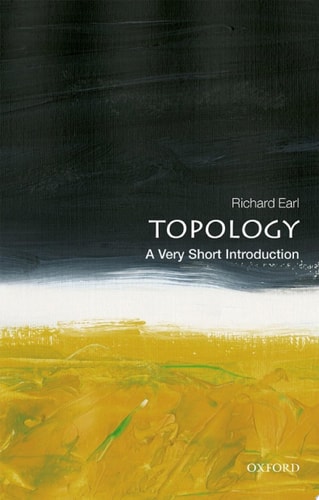
Topology: A Very Short Introduction
0
0
As an Amazon Associate and affiliate partner, Menrva Books earns from qualifying purchases. Learn more
Author Description
How is a subway map different from other maps? What makes a knot knotted? What makes the Möbius strip one-sided? These are questions of topology, the mathematical study of properties preserved by twisting or stretching objects. In the 20th century topology became as broad and fundamental as algebra and geometry, with important implications for science, especially physics. In this Very Short Introduction Richard Earl gives a sense of the more visual elements of topology (looking at surfaces) as well as covering the formal definition of continuity. Considering some of the eye-opening examples that led mathematicians to recognize a need for studying topology, he pays homage to the historical people, problems, and surprises that have propelled the growth of this field. ABOUT THE SERIES: The Very Short Introductions series from Oxford University Press contains hundreds of titles in almost every subject area. These pocket-sized books are the perfect way to get ahead in a new subject quickly. Our expert authors combine facts, analysis, perspective, new ideas, and enthusiasm to make interesting and challenging topics highly readable.
Menrva's Summary
THE THESIS
This book investigates the fundamental principles of topology, exploring how properties of objects remain invariant under continuous deformation. Richard Earl, a mathematician at the University of Oxford, utilizes historical context and visual examples to explain complex concepts such as continuity and surface geometry. The text serves as an accessible entry point for readers interested in understanding how topology functions as a core pillar of modern mathematics and physics.
THE SCOPE MAP
What You Will Find
- Explanations of topological properties like knots and the Möbius strip
- Formal definitions of continuity and its mathematical implications
- Historical overview of the development of topological thought
- Analysis of the relationship between topology, algebra, and geometry
Scope Limits
- Does not provide an exhaustive technical manual for advanced research
- Excludes highly specialized proofs found in graduate-level textbooks
THE AUTHORITY PERSPECTIVE
Readers frequently note the clarity and accessibility of the prose, which balances technical rigor with intuitive explanations. Experts highlight this as a foundational text for students and laypeople seeking a concise introduction to the field.
Page Count:
168
Publication Date:
2019-01-01
Publisher:
OUP Oxford
ISBN-10:
019256899X
ISBN-13:
9780192568991
Science
Post-Calculus
Geometry
Education
Topology
Mathematics
Mathematics Statistics
Community Tags
Other Editions(3)

Similar Books