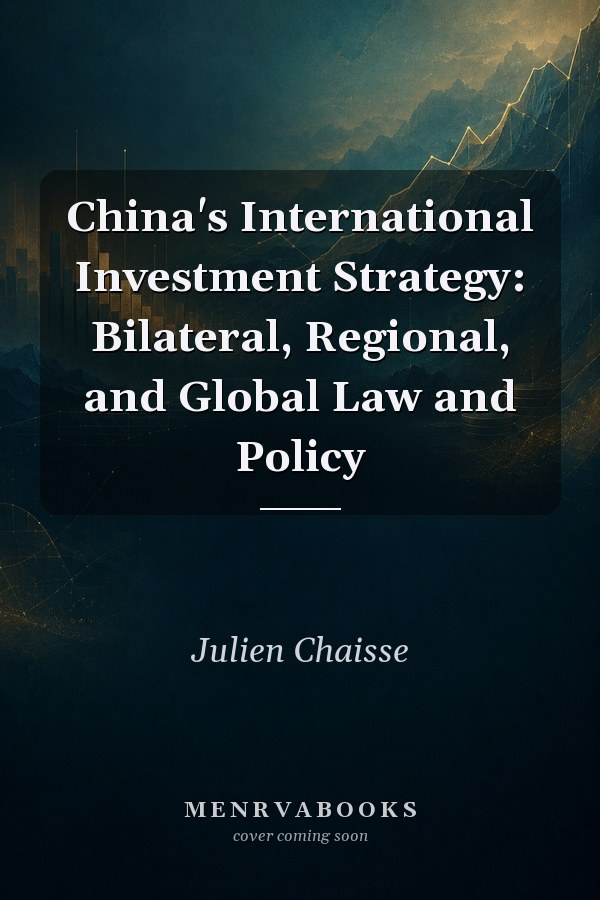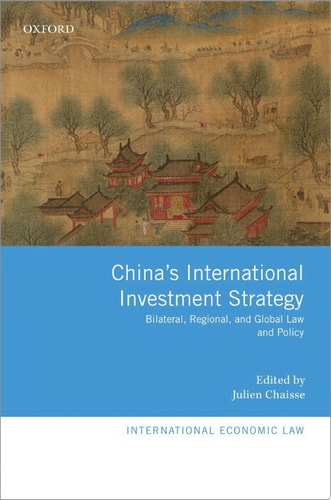
China's International Investment Strategy: Bilateral, Regional, and Global Law and Policy
0
0
As an Amazon Associate and affiliate partner, Menrva Books earns from qualifying purchases. Learn more
Author Description
Since China adopted its 'open door' policy in 1978, which altered its development strategy from self-sufficiency to active participation in the world market, its goal has remained unchanged: to assist the readjustment of China's economy, to coordinate its modernization programs, and to improve its quality of life. With the 1997 launch of the 'Going Global' policy, an outward focus regarding foreign investment was added, to circumvent trade barriers and improve the competitiveness of Chinese firms. In order to accommodate inward and outward investment, China's participation in the international investment regime has underpinned its efforts to join multilateral investment-related legal instruments and conclude international investment agreements. This collection, compiled by award-winning scholar Professor Julien Chaisse, explores the three distinct tracks of China's investment policy and strategy: bilateral agreements including those with the US and the EU; regional agreements including the Free Trade Area of the Asia Pacific; and global initiatives, spear-headed by China's presidency of the G20 and its 'Belt and Road initiative'. The book's overarching topic is whether these three tracks compete with each other, or whether they complement one another - a question of profound importance for the country's political and economic future and world investment governance.
Menrva's Summary
THE THESIS
This work investigates whether China's three-pronged investment strategy—comprising bilateral, regional, and global legal frameworks—functions as a cohesive, complementary system or a set of competing interests. Professor Julien Chaisse, an expert in international economic law, synthesizes legal analysis and policy review to evaluate how China’s 'Going Global' initiative interacts with international investment regimes. The text examines the evolution of Chinese economic policy from the 1978 'open door' era to contemporary global infrastructure projects, providing a framework for understanding how these legal instruments influence world investment governance.
THE SCOPE MAP
What You Will Find
- Analysis of bilateral investment treaties with the US and the EU.
- Examination of regional frameworks such as the Free Trade Area of the Asia Pacific.
- Evaluation of global initiatives including the Belt and Road Initiative and G20 leadership.
- Legal assessment of China's integration into multilateral investment-related instruments.
Scope Limits
- The text does not provide a comprehensive history of domestic Chinese economic reform outside the context of international investment law.
- It does not offer speculative predictions on future geopolitical outcomes beyond the stated legal and policy frameworks.
THE AUTHORITY PERSPECTIVE
Experts and legal scholars recognize this collection as a rigorous examination of the intersection between Chinese state policy and international economic law. Readers frequently note the academic density of the prose, which serves as a foundational resource for understanding the complexities of China's role in global investment governance.
Page Count:
557
Publication Date:
2019-01-01
Publisher:
OUP Oxford
ISBN-10:
0192562428
ISBN-13:
9780192562425
Economics
Professional Career & Trade
Foreign Policy
China Studies
China
International Investment
International Law