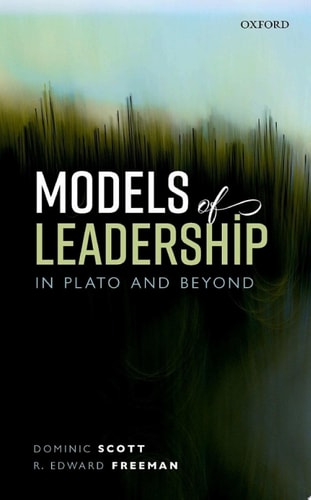
Models of Leadership in Plato and Beyond
0
0
As an Amazon Associate and affiliate partner, Menrva Books earns from qualifying purchases. Learn more
Author Description
Leadership has become a prevalent concept across a variety of disciplines, among them history, politics, management studies, economics, and psychology. An array of definitions and theories have been proposed both by those who study leadership, and by those in leadership positions themselves. Here, Dominic Scott and R. Edward Freeman adopt a highly innovative approach by going back to one of the greatest thought leaders of all time, the Greek philosopher Plato. Plato brought a richness and complexity to common ideas about the nature and purpose of leadership. Rather than attempting to give a single 'one-size-fits-all' definition, his strategy was to break it into its different strands. He presents several 'models' of leadership, mostly through images or analogies: the leader as doctor, navigator, artist, teacher, shepherd, weaver, or sower. Each model points to features of leadership that we intuitively recognize to be important, and which still carry significant weight today, such as curing a social malaise or charting a new course. Scott and Freeman set out the essentials of Plato's thought and illustrate each model through modern case studies, including presidents, CEOs, and Nobel laureates. They also measure Plato's models against more recent concepts, using his insights to throw light on contemporary theory and practice. With a principal focus on leadership, and an assumption of no prior knowledge of Plato's works, this book takes a multi-faceted approach to a complex phenomenon.
Menrva's Summary
THE THESIS
This book investigates whether the ancient philosophical frameworks of Plato can provide a more nuanced understanding of modern leadership than contemporary, singular definitions. R. Edward Freeman and Dominic Scott, scholars in management and philosophy respectively, utilize Plato's dialogues to deconstruct leadership into distinct, functional models. By moving away from a one-size-fits-all approach, they argue that leadership is a multifaceted phenomenon that requires different skills depending on the context, such as the roles of navigator, doctor, or weaver.
THE SCOPE MAP
What You Will Find
- An analysis of seven distinct Platonic leadership archetypes: doctor, navigator, artist, teacher, shepherd, weaver, and sower.
- Comparative analysis between ancient Greek political philosophy and modern management theory.
- Modern case studies featuring CEOs, political figures, and Nobel laureates to illustrate the application of these models.
Scope Limits
- The text does not provide a comprehensive history of Western political thought beyond the specific lens of leadership.
- It does not offer a prescriptive 'how-to' manual for corporate management, focusing instead on conceptual frameworks.
THE AUTHORITY PERSPECTIVE
Experts highlight this work as a bridge between classical philosophy and contemporary organizational studies, noting its accessibility for readers without a background in Greek thought. Readers frequently observe that the book successfully avoids academic jargon while providing a rigorous intellectual foundation for evaluating modern leadership practices.
Page Count:
240
Publication Date:
2021-01-01
Publisher:
OUP Oxford
ISBN-10:
0192574299
ISBN-13:
9780192574299
Philosophy
Motivation
Management
Leadership
Ethics
Community Tags
Similar Books