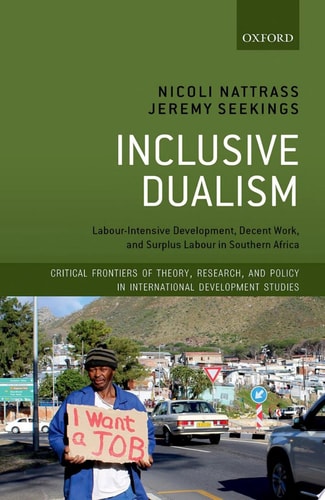
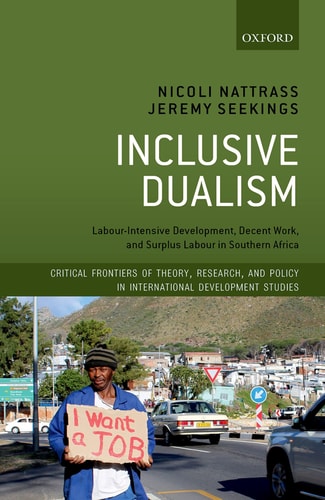
Inclusive Dualism: Labour-intensive Development, Decent Work, and Surplus Labour in Southern Africa
0
0
As an Amazon Associate and affiliate partner, Menrva Books earns from qualifying purchases. Learn more
Author Description
W. Arthur Lewis, the founding father of development economics, proposed a dualist model of economic development in which 'surplus' (predominantly under-employed) labour shifted from lower to higher productivity work. In practice, historically, this meant that labour was initially drawn out of subsistence agriculture into low-wage, labour-intensive manufacturing, including in clothing production, before shifting into higher-wage work. This development strategy has become unfashionable. The International Labour Organisation (ILO) worries that low-wage, labour-intensive industry promises little more than an impoverishing 'race to the bottom'. Inclusive Dualism: Labour-intensive Development, Decent Work, and Surplus Labour in Southern Africa argues that decent work fundamentalism, that is the promotion of higher wages and labour productivity at the cost of lower-wage job destruction, is a utopian vision with potentially dystopic consequences for countries with high open unemployment, many of which are in Southern Africa. Using the South African clothing industry as a case study Inclusive Dualism argues that decent work fundamentalism ignores the inherently differentiated character of industry resulting in the unnecessary destruction of labour-intensive jobs and the bifurcation of society into highly-paid, high-productivity insiders and low-paid or unemployed outsiders. It demonstrates the broader relevance of the South Africa case, examining the growth in surplus labour across Africa. It shows that low- and high-productivity firms can co-exist, and challenges the notion that a race to the bottom is inevitable. Inclusive Dualism instead favours multi-pronged development strategies that prioritise labour-intensive job creation as well as facilitating productivity growth elsewhere without destroying jobs.
Menrva's Summary
THE THESIS
Does the pursuit of 'decent work' standards in developing economies inadvertently exacerbate unemployment by destroying low-wage, labor-intensive job opportunities? Jeremy Seekings and Nicoli Nattrass, both established scholars in social and economic policy, utilize historical economic frameworks and contemporary labor data to challenge the prevailing orthodoxy of the International Labour Organisation. They argue that prioritizing high-wage, high-productivity mandates in countries with significant surplus labor creates a bifurcated society, ultimately harming the very workers these policies intend to protect.
THE SCOPE MAP
What You Will Find
- Analysis of the Lewis dualist model of economic development.
- Case study of the South African clothing manufacturing industry.
- Examination of labor market dynamics across various African nations.
- Theoretical framework for multi-pronged development strategies.
Scope Limits
- The text focuses primarily on the Southern African context and may not apply universally to all global emerging markets.
- It does not provide a comprehensive guide to corporate management or micro-level firm operations.
THE AUTHORITY PERSPECTIVE
Experts recognize this work as a critical intervention in development economics that challenges the 'decent work' consensus. Readers frequently note the academic density of the prose and the authors' rigorous application of historical data to modern policy debates.
Page Count:
264
Publication Date:
2019-01-01
Publisher:
Oxford University Press
ISBN-10:
0192578472
ISBN-13:
9780192578471
Economics
Social Science
Labor Studies
Public Policy
Southern Africa
Community Tags
Other Editions(2)
Similar Books









Reader Comments
Share Your Thoughts
No comments yet. Be the first to share your thoughts!