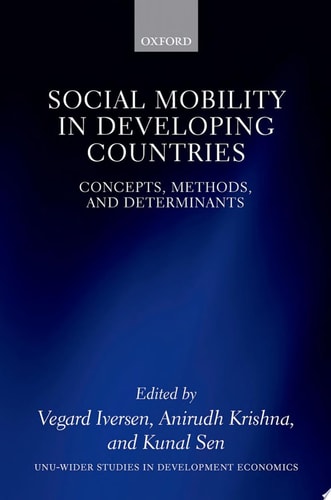
Social Mobility in Developing Countries: Concepts, Methods, and Determinants
0
0
As an Amazon Associate and affiliate partner, Menrva Books earns from qualifying purchases. Learn more
Author Description
Social mobility is the hope of economic development and the mantra of a good society. There are disagreements about what constitutes social mobility, but there is broad agreement that people should have roughly equal chances of success regardless of their economic status at birth. Concerns about rising inequality have engendered a renewed interest in social mobility--especially in the developing world. However, efforts to construct the databases and meet the standards required for conventional analyses of social mobility are at a preliminary stage and need to be complemented by innovative, conceptual, and methodological advances. If forms of mobility have slowed in the West, then we might be entering an age of rigid stratification with defined boundaries between the always-haves and the never-haves-which does not augur well for social stability.Social mobility research is ongoing, with substantive findings in different disciplines--typically with researchers in isolation from each other. A key contribution of this book is the pulling together of the emerging streams of knowledge. Generating policy-relevant knowledge is a principal concern.Three basic questions frame the study of diverse aspects of social mobility in the book. How to assess the extent of social mobility in a given development context when the datasets by conventional measurement techniques are unavailable? How to identify drivers and inhibitors of social mobility in particular developing country contexts? How to acquire the knowledge required to design interventions to raise social mobility, either by increasing upward mobility or by lowering downward mobility?
Menrva's Summary
THE THESIS
This volume investigates how social mobility can be accurately measured, understood, and influenced within the specific constraints of developing nations. The authors, Anirudh Krishna, Kunal Sen, and Vegard Iversen, synthesize interdisciplinary research to address the lack of conventional longitudinal data in emerging economies. They argue that by integrating innovative conceptual frameworks with localized methodological approaches, policymakers can better identify the drivers of mobility and design effective interventions to reduce stratification.
THE SCOPE MAP
What You Will Find
- Conceptual frameworks for defining social mobility in non-Western contexts
- Methodological strategies for assessing mobility when standard datasets are absent
- Analysis of the structural drivers and inhibitors of upward and downward mobility
- Policy-oriented research aimed at improving economic opportunity
Scope Limits
- Does not provide a singular, universal model for all developing nations
- Does not focus on developed Western economies except as a point of comparative contrast
THE AUTHORITY PERSPECTIVE
Experts recognize this work as a significant contribution to development economics for its attempt to bridge the gap between disparate academic disciplines. Readers frequently note the academic density of the prose, which serves as a rigorous resource for researchers and policy practitioners interested in social stratification.
Page Count:
512
Publication Date:
2022-03-21
Publisher:
Oxford University Press
ISBN-10:
0192896857
ISBN-13:
9780192896858
Economics
Sociology
Social Science
Public Policy
Community Tags
Similar Books