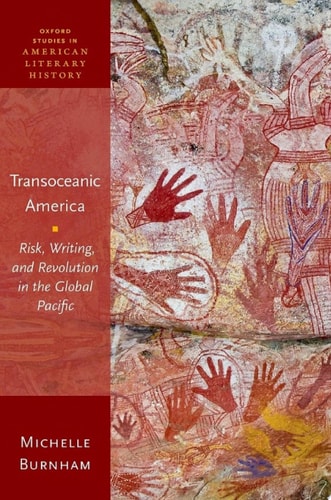
Transoceanic America: Risk, Writing, and Revolution in the Global Pacific
0
0
As an Amazon Associate and affiliate partner, Menrva Books earns from qualifying purchases. Learn more
Author Description
Transoceanic America offers a new approach to American literature by emphasizing the material and conceptual interconnectedness of the Atlantic and Pacific worlds. These oceans were tied together economically, textually, and politically, through such genres as maritime travel writing, mathematical and navigational schoolbooks, and the relatively new genre of the novel. Especially during the age of revolutions in the late eighteenth and early nineteenth centuries, long-distance transoceanic travel required calculating and managing risk in the interest of profit. The result was the emergence of a newly suspenseful form of narrative that came to characterize capitalist investment, political revolution, and novelistic plot. The calculus of risk that drove this expectationist narrative also concealed violence against vulnerable bodies on ships and shorelines around the world. A transoceanic American literary and cultural history requires new non-linear narratives to tell the story of this global context and to recognize its often forgotten textual archive.
Menrva's Summary
THE THESIS
How did the intersection of maritime risk management and transoceanic commerce shape the development of American literary forms during the age of revolutions? Michelle Burnham, a scholar of early American literature, examines the material and conceptual links between the Atlantic and Pacific worlds. By analyzing maritime travelogues, navigational texts, and early novels, she argues that the capitalist drive to calculate risk fostered a specific narrative structure characterized by suspense and expectation. This framework, she contends, simultaneously enabled economic expansion and obscured the systemic violence inflicted upon marginalized populations across global shorelines.
THE SCOPE MAP
What You Will Find
- Analysis of late eighteenth and early nineteenth-century maritime travel writing and schoolbooks.
- A theoretical framework connecting capitalist risk management to novelistic plot structures.
- Examination of the textual archive regarding transoceanic trade and political revolution.
Scope Limits
- The study does not provide a comprehensive history of all American maritime literature.
- It focuses primarily on the intersection of risk and narrative rather than a broad survey of Pacific literature.
THE AUTHORITY PERSPECTIVE
Scholars in the field of American literary history recognize this work as a significant contribution to the study of transoceanic connections and the material culture of early American texts. Readers frequently note the academic density of the prose and the rigor with which Burnham connects economic history to literary form.
Page Count:
300
Publication Date:
2019-01-01
Publisher:
OUP Oxford
ISBN-10:
019257759X
ISBN-13:
9780192577597
English & College Success
English
Atlantic Studies
American History
Literary Criticism
Maritime history
Community Tags
Similar Books