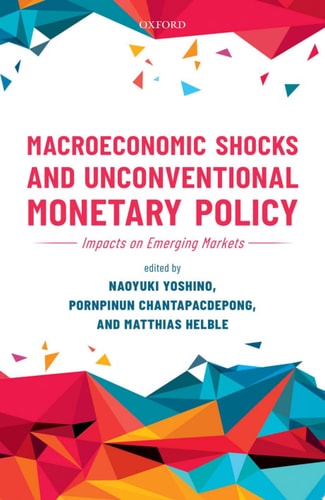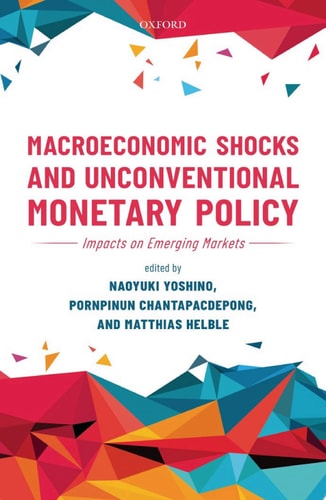
Macroeconomic Shocks and Unconventional Monetary Policy: Impacts on Emerging Markets
0
0
As an Amazon Associate and affiliate partner, Menrva Books earns from qualifying purchases. Learn more
Author Description
Barely two decades after the Asian financial crisis Asia was suddenly confronted with multiple challenges originating outside the region: the 2008 global financial crisis, the European debt crisis, and finally developed economies' implementation of unconventional monetary policies. The implementation of quantitative easing, ultra-low interest rate policies, and negative interest rate policies by a number of large central banks has given rise to concerns over financial stability and international capital flows. Macroeconomic Shocks and Unconventional Monetary Policy: Impacts on Emerging Markets explains how shocks stemming from the global financial crisis have affected macroeconomic and financial stability in emerging Asia. Macroeconomic Shocks and Unconventional Monetary Policy: Impacts on Emerging Markets brings together the most up-to-date knowledge impacts of recent macroeconomic shocks on Asia's real economy; the spillover effects of macroeconomic shocks on financial markets and flows in Asia; and key challenges for monetary, exchange rate, trade and macro prudential policies of developing Asian economies. It is authored by experts in the field of international macroeconomics from leading academic institutions, central banks, and international organizations including the International Monetary Fund, the Bank for International Settlement, and the Asian Development Bank Institute.
Menrva's Summary
THE THESIS
This work investigates how external macroeconomic shocks and unconventional monetary policies in developed nations have influenced the financial stability and economic growth of emerging Asian markets. The authors, including experts from the International Monetary Fund, the Bank for International Settlements, and the Asian Development Bank Institute, utilize empirical data and policy analysis to evaluate the transmission mechanisms of global financial instability. They present a framework for understanding how quantitative easing and ultra-low interest rates in advanced economies create spillover effects that complicate domestic policy management in developing regions.
THE SCOPE MAP
What You Will Find
- Analysis of the 2008 global financial crisis and the European debt crisis impacts on Asia.
- Evaluation of quantitative easing and negative interest rate policy spillovers.
- Discussion of macroprudential policy responses and exchange rate management.
- Research contributions from central bank officials and international economic organizations.
Scope Limits
- The text focuses primarily on emerging Asian economies rather than a global survey of all developing nations.
- It does not provide a comprehensive history of monetary theory, focusing instead on post-2008 developments.
THE AUTHORITY PERSPECTIVE
Experts identify this volume as a technical resource for policymakers and researchers focusing on the intersection of international finance and regional economic stability. Readers frequently note the academic density of the prose, which assumes a foundational understanding of macroeconomic principles and central banking operations.
Page Count:
344
Publication Date:
2019-01-01
Publisher:
OUP Oxford
ISBN-10:
0192575198
ISBN-13:
9780192575197
Economics
Finance
Money & BankingMonetary Theory
Principles of Macroeconomics
Macroeconomics
International relations
Asia